
by Asher Lehrer-Small, The Guardian
Since Texas lawmakers in 2021 passed a ban on lessons teaching that any one group is “inherently racist, sexist or oppressive”, a little-noticed provision of that legislation has triggered a massive fallout for civics education across the state.

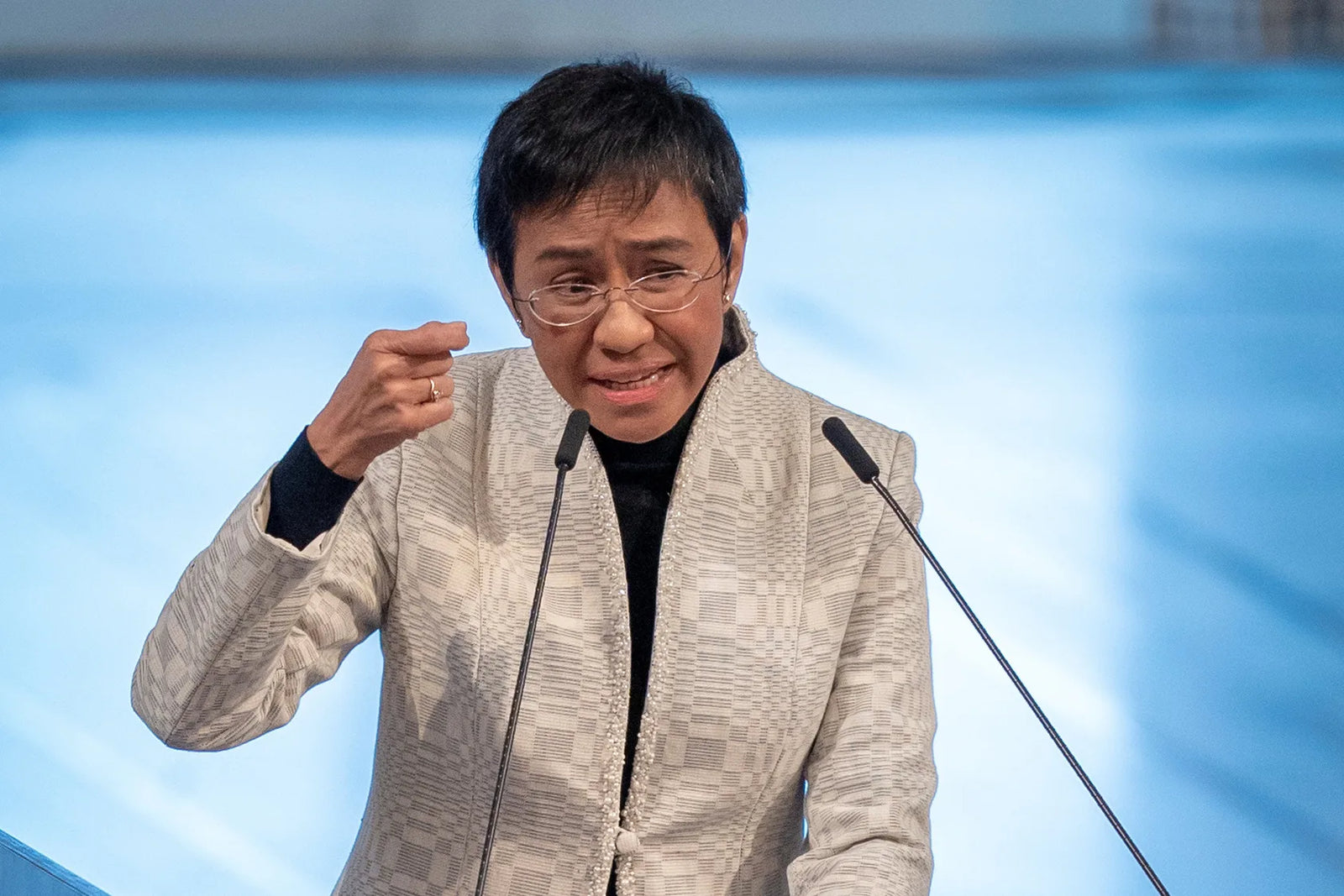
Maria Ressa, Class of 1986, received the Nobel Peace Prize in 2021 for her efforts to safeguard freedom of expression in the Philippines.

Ryan Quinn
Inside Higher Ed
Excerpt: Columbia University’s acting president says the institution is incorporating the controversial International Holocaust Remembrance Alliance definition of antisemitism into the Office of Institutional Equity’s work. That office investigates discrimination complaints against students and employees.
“Formally adding the consideration of the IHRA definition into our existing anti-discrimination policies strengthens our approach to combating antisemitism,” Claire Shipman said in a statement Tuesday announcing “additional commitments to combatting antisemitism.”
Gabe Kaminsky, Madeleine Rowley, and Maya Sulkin
The Free Press
Excerpt: On Saturday evening, federal immigration authorities arrested an anti-Israel activist who helped lead protests against the Jewish state on Columbia University’s campus after Hamas’s October 7, 2023 attack. As progressive activists and free speech advocates protested the move to revoke Mahmoud Khalil’s green card over civil liberties concerns Monday, President Donald Trump warned that Khalil’s arrest would be the first “of many to come.”
Khoa Sands ‘26
Campus free speech has rarely been as salient as in the past months. The Israel-Hamas War has supercharged campus activists and the ongoing debate on free speech and the mission of the university. On December 6th, the presidents of Harvard, UPenn, and M.I.T. testified at a disastrous House hearing where they seemed to be unable to take a position against calling for the genocide of Jews. Alumni, students, faculty, and donors were outraged. Four days later, the President of UPenn, Liz Magill, resigned and calls have been growing for the resignation of Claudine Gay, President of Harvard. In the background of this affair has been a series of pro-Palestine protests at university campuses across the country, often crossing the boundary into open anti-semitism. In such an environment, it is hard to feel welcome as a Jewish student.

Maryanne Wolf is a neuroscientist of reading. Princeton asked her to teach the Class of 2030 how to reckon with difficult language. Little could be more necessary at a moment of vanishing attention spans and visceral intolerance for language upsetting to its audience. Which makes it surprising that at Opening Exercises Wolf had a hard time finishing a sentence. She collapsed into her armchair, announced that she could not say “his name,” and spelled “T-R-U-M-P” to 1,300 first-years. Princeton President Christopher Eisgruber, sitting across from her, smiled and said nothing.
Some criticism has come for Eisgruber, but who knows what his snap reaction really means. What’s shocking is that ten years after his first election victory, the name of the sitting president of the United States is treated as some kind of hex. The university that assigned incoming freshmen Wolf’s Reader, Come Home: The Reading Brain in a Digital World — meant to foster courage in encountering challenging sentences — somehow failed once again to display a modicum of maturity when it counted. A decade on, is it possible that we’re still not ready to speak about the president without hyperventilation—or treating his name as a curse, or a trigger?
Tal Fortgang ’17 is a Legal Policy Fellow at the Manhattan Institute, a regular contributor to PFS and a contributing writer at The Dispatch.

“T-R-U-M-P.”
Neuroscientist Maryanne Wolf was answering a student’s question when she nearly used the word “trump” as a regular English verb, meaning “override” or “overcome” — but she couldn’t bring herself to finish her sentence. She collapsed into her armchair, citing her inability to say “his name” out loud, and instead spelled it out, letter by letter. At the Princeton Pre-read assembly, in front of the entire Class of 2030. University President Christopher Eisgruber ’83, sitting across from her, smiled and said nothing.

The good news is that the percentage of colleges and universities earning FIRE's "red light" (bad) rating has reached a low of 13 percent — a 55 percent drop since the "Spotlight" report began in 2006, and a 1.5 percent drop from last year. The bad news is that Princeton is among that 13 percent. Princeton is still found to maintain policies that "clearly and substantially" restrict free expression.

Incidents decreased most significantly on college and university campuses, by 66% (from 1,694 to 583).
The most significant factor contributing to the decrease in incidents on college campuses in 2025 was the decline of the anti-Israel encampment movement that drove the spike in incidents on campuses in the spring of 2024. Antisemitic incidents related to anti-Israel protests, including encampments, decreased by 83% on college campuses in 2025 compared to the year before. But the threat of antisemitism on college campuses is far from gone. Incidents on college campuses remained almost three times higher in 2025 than in 2021.

Kate Hidalgo Bellows
Chronicle of Higher Education
Excerpt: The Trump administration has sent its first notice to a college that it may take away federal funding.
A new federal task force on antisemitism will review more than $5 billion that Columbia University receives from the government, and will immediately consider imposing stop-work orders on $51.4 million in federal contracts that Columbia holds.

ACE, joined by 22 other national higher education associations, filed an amicus brief yesterday with the U.S. Court of Appeals for the First Circuit supporting Harvard University in its lawsuit challenging a Trump administration effort to bar international students from attending.
The brief urges the appeals court to affirm a preliminary injunction issued by U.S. District Judge Allison D. Burroughs last June that blocked enforcement of a presidential proclamation that would have suspended the entry of foreign nationals seeking to study at Harvard.
Foundation for Individual Rights in Expression
Excerpt: Charlie Kirk was shot during an event at Utah Valley University today. Details of the incident are still unfolding.
Political violence is never an acceptable response to speech. Free speech allows us to settle our differences peacefully and is essential to a free and democratic society.
Our thoughts are with Charlie Kirk and his family.
Igor Mazin
Inside Higher Ed
Excerpt: Ages ago, in the 1970s Soviet Union, a Jewish stand-up comedian, Mikhail Zhvanetski, remarked in one of his skits that if you want to argue about the taste of coconuts (not available in the Soviet Union at that time), it’s better to talk to those who’ve actually tried them. If you want to argue about antisemitism in academia, better ask those who have actually experienced it. Ask me.
The U.S. Department of Education is taking seriously a charge of “a pervasive hostile environment for Jewish students and faculty” at George Mason. This is as shocking to me (and to many of my Jewish colleagues at GMU) as hearing that I have broken two legs and never noticed it.
Samuel A. Church and Cam N. Srivastava
Harvard Crimson
Excerpt: At an information session with more than 500 attendees, Harvard staff told international students to expect tight screening at Boston Logan International Airport and keep a careful handle on their internet presence, which could be vetted for pro-Palestine posts.
Harvard University
Excerpt: This is the Final Report of the Presidential Task Force on Combating Antisemitism and Anti-Israeli Bias.
This report summarizes the findings of the Task Force’s study of conditions at Harvard University. We gathered oral and written documentation between March and September 2024, and we devoted the rest of 2024 and beginning of 2025 to writing the report. Our work involved meeting with hundreds of students, faculty, and staff in listening sessions for specific segments of the campus community as well as private conversations with individuals. We also met with members of the wider Harvard community, including alumni. In our outreach, we spoke with non-Jews, American Jews, and Jewish and Arab citizens of the State of Israel within the Harvard community.
Jack Fowler
National Review
Excerpt: For reputation-tattered Cornell University, 2024 was a bad year — the pain self-inflicted. As the school prepares for late-February elections of alumni members to the Board of Trustees, one wonders: Will 2025 deliver another (self-infliction encore!) Ivy League black eye?
Some concerned graduates are refusing complacency while the university board relentlessly rubber-stamps the administration’s ideological obsessions, tarnishing the once-prestigious brand. They have grabbed an opportunity -- the formal, annual election of two new alumni trustees -- to put two fresh-thinking, independent, and unendorsed (more on that below) candidates on the ballot.
Bobby Ramkissoon
FIRE
Excerpt: Amid the urban hum of downtown Seattle and the friendly clatter of a FIRE supporters’ meetup, a consequential alliance was born.
Two alumni of the University of Washington, separated by generations but united by a shared purpose, converged in conversation. Cole Daigneault, a freshly minted graduate from the class of 2024, and Bill Severson, a two-time UW graduate who earned his bachelor’s and law degree in the early 1970s, lamented over the encroaching illiberalism at their alma mater. That evening’s conversation, later sustained through an alumni email listserv, soon crystallized into Husky Alumni for Academic Excellence.
Matthew Wilson, Daily Princetonian
Excerpt: As I write this essay, the despicable poison of Jew-hatred has taken a firm hold at so many college campuses, Princeton included. Here at Princeton, activists proudly chant “Intifada” and demand the complete eradication of the world’s only Jewish state; elsewhere, from Cornell, Harvard, and the University of Pennsylvania to Ohio State and Cooper Union, frightening (and sometimes violent and illegal) exhibitions of anti-Jewish attitudes abound.
For the most part, university responses to these shameful displays have been tepid and restrained. these same universities, despite being so reticent to speak out now, have a prolonged public history of weighing in on a wide array of hotly contested and politically controversial topics. At Princeton, for instance, recent years have seen official statements issued deploring Supreme Court rulings on abortion and affirmative action, condemning a jury verdict, and attacking a professor for his political views. On Hamas’s terrorist attacks? No official statements.

A federal judge has granted an additional tranche of colleges a delay before they must submit newly required data to the U.S. Department of Education on their applicants, admits and enrollees broken down by race and sex.
Institutional members of two higher education groups — the Association of American Universities and the Association of Independent Colleges and Universities in Massachusetts — will now have until April 14 to submit the data.

The U.S. Department of Education’s top ranking higher education official sent letters to two accreditors Monday directing them to eliminate their diversity, equity and inclusion standards that he contended were in violation of civil rights law.
In his letters, Kent said the Education Department would continue to recognize the two accreditors but warned that officials could take action against them — including pulling that recognition — if they enforce any of their suspended DEI standards before formally eliminating them. His letters escalate the Trump administration’s crackdown on DEI standards at accrediting agencies.

Texas Tech leaders have somehow convinced themselves that race and gender are not legitimate topics to discuss in a psychology class. That’s absurd on its face: You can’t teach human behavior while treating basic dimensions of human identity as off-limits.
Will Crescioni, a lecturer in Texas Tech’s Department of Psychological Sciences, submitted his course materials for his honors-level psychology course the same day the Texas Tech system issued a memo ordering universities to review courses and ensure faculty do not “promote or otherwise inculcate” certain ideas related to race and gender. Just over a month later — and only two days before the semester began — his course was scrapped. His offense? Refusing to alter his course content.
Calvin Kenjiro Grover and Luke Grippo
Daily Princetonian
Excerpt: More than a year ago, pro-Palestine protesters concluded a three week-long sit-in with an ominous message: “See you at Reunions.”
While the subsequent disruptions at that year’s Reunions and Commencement were far less dramatic than the ‘Gaza Solidarity Encampment,’ they were, for Princeton, still substantial: blood-colored dye in the SPIA fountain, a loud walkout at a speech by University President Christopher Eisgruber ’83, and even an attempt to block the P-Rade.
Lexi Lona Cochrane
The Hill
Excerpt: President Trump said Tuesday that he will seek to block the federal funding for colleges and universities “that allow illegal protests” on their campuses.
“All Federal Funding will STOP for any College, School, or University that allows illegal protests. Agitators will be imprisoned/or permanently sent back to the country from which they came,” the president wrote in a Truth Social post, though he did not specify an enforcement mechanism.