By Francesca Block, Princeton '22
March 23, 2023
The system of punishment at Stanford is more than a decade old. Class of 1977 alum Bob Ottilie, . . .who has represented over 100 students investigated by Stanford since 2011, said a majority choose to admit responsibility and accept a lesser punishment through an “early resolution option,” which is like a plea deal. While some take this approach because they committed the violation, he said many choose it because they feel the odds are stacked against them. He sees Stanford’s disciplinary process not as a system designed to find truth, but to punish “bad behavior.” “Think about that,” he added. “That’s a presumption of guilt.” . . . In an April 2021 report, [a Stanford] committee concluded that the university’s disciplinary process is “overly punitive” and “not educational.” Less than one year later, Katie Meyer was dead.

by Miriam Waldvogel and Jeannie Kim, Daily Princetonian
At a conference on Friday, May 5, executives from oil and gas companies British Petroleum (BP) and members of the University’s Carbon Mitigation Initiative (CMI), an academic research program within the High Meadows Environmental Institute, were met the sight of students lying on the Julius Romo Rabinowitz (JRR) atrium floor with their mouths duct-taped and eyes closed.

President Christopher Eisgruber ’83 is “very proud” of University students’ commitment to free speech, he said at an event hosted on Saturday by the Princeton Progressive Law Society.

by Jeremy Bauer-Wolf, Higher Ed Dive
The nation’s leading faculty group has accused Emporia State University of imperiling academic freedom when it laid off at least 30 professors last year over financial concerns.
In the latest example of students shutting down views they disagree with on campus, Whitworth University’s student government denied the campus Turning Point USA chapter’s request to invite Chinese dissident Xi Van Fleet to campus because of her criticism of “woke culture.”

The extremist attacks on free speech (from right and left) degrade American democracy, and those attacks are especially acute on college campuses, whether they come from angry left-wing students who shout down conservative speakers or from vengeful right-wing legislators.
by Keith Whittington, Reason
The Academic Freedom Alliance recently released the third episode of The Academic Freedom Podcast. In that episode, I spoke with Brookings Institution scholar Jonathan Rauch.
Jacob Sullum
Reason Magazine
Excerpt: Mahmoud Khalil, a legal permanent resident who was the first target of President Donald Trump's crusade against foreign students he calls "terrorist sympathizers," could soon be released from custody thanks to a preliminary injunction that a federal judge in New Jersey granted this week. The reasoning behind that injunction underlines the chilling impact of Trump's attempt to treat speech he does not like as a deportable offense.
[U.S. District Judge Michael] Farbiarz stayed his injunction until 9:30 this morning to allow for a government appeal of his decision. That deadline came and went without an appeal. An Immigration and Customs Enforcement (ICE) official nevertheless told Khalil's lawyers "the government has no immediate plans to release him," The New York Times reports.
Schuyler Mitchell
The Intercept
Excerpt: New York University School of Law barred 31 pro-Palestine law school students from campus facilities and demanded that they sign away their right to protest in exchange for being allowed to return. If the students — deemed “personae non grata,” or PNG — don’t renounce their right to protest on campus, they will be unable to sit for final exams.

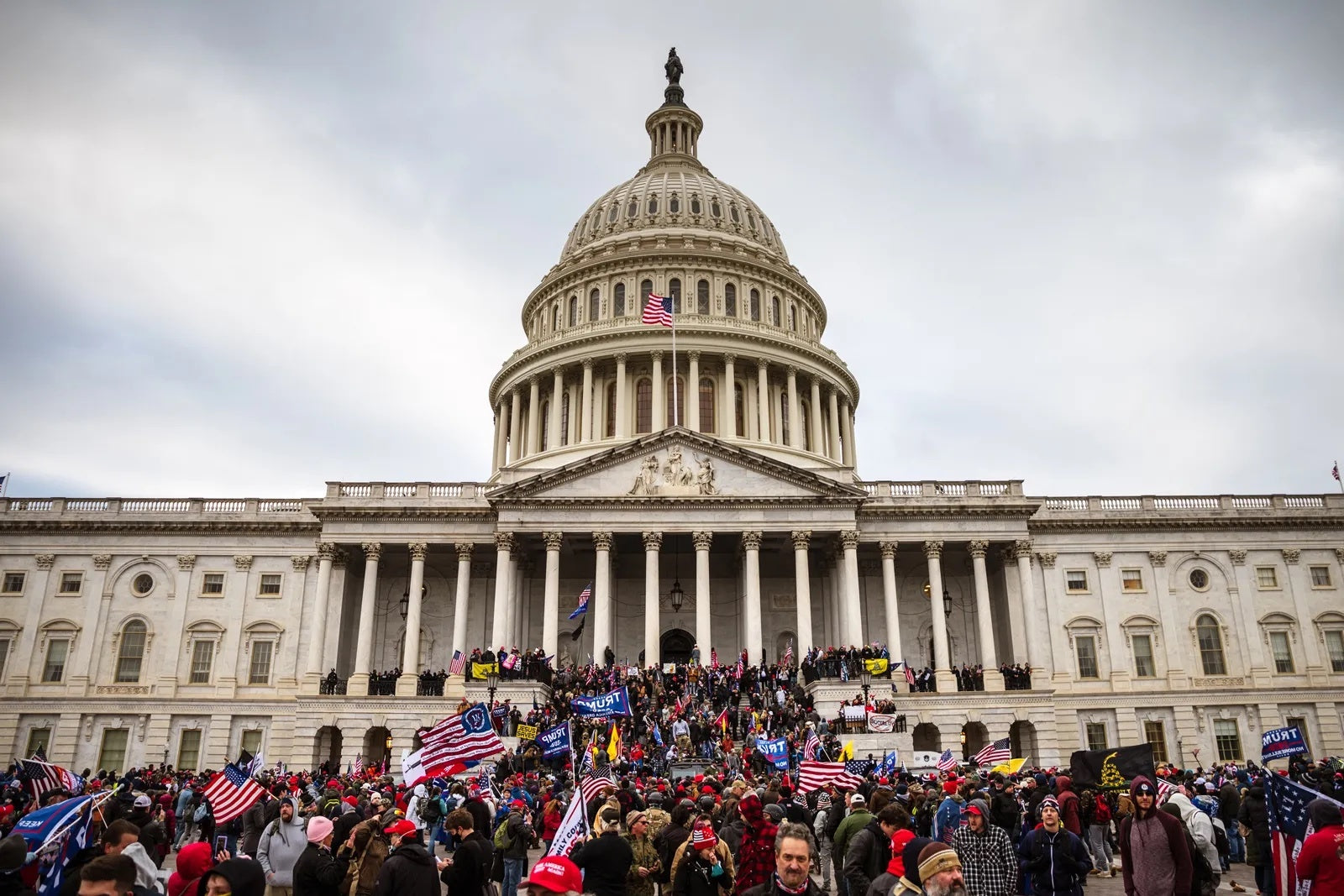
On March 14, the Department of Justice (DOJ) announced Larry Giberson ’23 was arrested in relation to the Capitol riot on Jan. 6, 2021. Giberson, a politics major from Manahawkin, New Jersey...

Universities don’t have to choose between protecting Jewish students and championing freedom of speech. In fact, federal law requires them to do both. Yet when my alma mater, Brown University, resolved a federal civil rights investigation in July 2025, the line between protected speech and unprotected conduct was unnecessarily blurred.
In short emails in July, Princeton President Christopher Eisgruber spurned a distinguished professor's plea to take seriously the letter and spirit of Princeton's free speech rule.

The University has implemented rules prohibiting reporters from recording, photographing, or filming faculty meetings. The new rules went into effect from the May 11 faculty meeting, marking a departure from past practices in which reporters were able to record meetings for transcription and take photographs of the Faculty Room inside Nassau Hall.
The new rules also limit the number of reporters to two per campus publication and stipulate that reporters notify the Office of Communications of their attendance at least 24 hours in advance of meetings. Campus press must also obtain media credentials before each faculty meeting. Campus radio remains permitted to broadcast faculty meetings, though no campus radio station currently broadcasts the meetings.

For the good of the Nation, university leadership must seize this occasion to drive essential reforms—a process some began by adopting positions of institutional neutrality and improving policies related to campus protests. Before the end of 2026, I call on every postsecondary institution to describe to the American public your commitments to rigorous teaching, pathbreaking research, and national service—commitments that make our universities a bedrock institution of the American republic.
Ryan Quinn
Inside Higher Ed
Excerpt: Protests of a Turning Point USA event at the University of California, Berkeley, campus Monday sparked arrests and investigation announcements from top U.S. Department of Justice officials, who alleged “Antifa” involvement. The DOJ was already investigating the UC system over various allegations, and the Trump administration has demanded UCLA pay $1.2 billion and make other concessions.
“Antifa is an existential threat to our nation,” Attorney General Pam Bondi posted on X Tuesday. “The violent riots at UC Berkeley last night are under full investigation by the FBI-led Joint Terrorism Task Force.”

The University of California, Los Angeles, is the latest university to fire an employee for making negative comments about Charlie Kirk after his killing last fall, the Los Angeles Times reported.
After a gunman killed right-wing influencer Charlie Kirk during an event at Utah Valley University last September, Johnathan Perkins, director of Race and Equity at UCLA, shared his reaction in a series of posts on Bluesky. “Good riddance,” read one; “It is OKAY to be happy when someone who hated you and called for your people’s death dies—even if they are murdered,” read another. And finally, “I’m always glad when bigots die.”
Click here for link to full article

Defending the rights of students and faculty to speak freely has been part and parcel of FIRE’s mission for 26 years. We’ve seen universities try all sorts of ways to restrict expression, from free speech zones and excessive security fees to extensive pre-approval requirements for events. But one technique is particularly disturbing — using ostensibly pro-free speech policies to chill student and faculty expression.
Katherine Knott
Inside Higher Ed
First-time undergraduates applying for federal student aid will now receive a warning if they indicate interest in an institution where graduates don’t earn more than an adult with a high school diploma.
The new earnings indicator on the Free Application for Federal Student Aid is aimed at ensuring students have more information about their postsecondary options, Education Department officials said in a news release Monday. Consumer protection advocates generally praised the department’s move, while institutional groups criticized it.
Kathryn Palmer
Inside Higher Ed
Excerpt: The Trump administration has made another move that historians say is an attempt to sanitize American history, but one the administration argued is necessary to ensure students have respect for the country.
Last week, Education Secretary Linda McMahon outlined a new plan for how her department would promote “patriotic education” by adding it to the list of priorities that can drive decisions for discretionary grants, including those that support programs at colleges and universities.
Dr. Kendall Conger
RealClearInvestigations
Excerpt: I was heartened to see my former employer, Duke University Health System, quietly reverse its commitment to woke racism this year. I had joined the internal resistance to its diversity, equity, and inclusion crusade and was fired because of it.
I worked at Duke for 10 years without incident before spending the last few years of my tenure battling the 2021 policy – at the cost of my job as an emergency room physician, which is now the subject of a separate lawsuit I have brought. As much as I would like to proclaim victory, I do not want this episode to get memory-holed by organizational leaders who would rather we forget the moral panic that gripped them and the price many of us paid for their destructive and divisive efforts.
Jessica Blake
Inside Higher Ed
Excerpt: House Republicans on the Ways and Means Committee released the full version of a long-awaited tax bill Monday that does for higher ed exactly what they suggested it would in a draft version Friday: dramatically increase the excise tax on wealthy colleges’ endowments.
If the legislation passes, the tax rate for each institution would range from 1.4 to 21 percent, depending on the size of its endowment and the number of students it enrolls, according to the 339-page bill. As with the existing endowment tax, the increases would apply only to private institutions.
Caroline G. Hennigan and Bradford D. Kimball, Crimson Staff Writers
Harvard Crimson
Excerpt: The Harvard Law School student body voted on Thursday to call on the University to divest from Israel — delivering a decisive endorsement of language that Law School administrators harshly criticized before it went up for a vote.
The resolution, which called on Harvard to “divest from weapons, surveillance technology, and other companies aiding violations of international humanitarian law, including Israel’s genocide in Gaza and its ongoing illegal occupation of Palestine,” passed with 72.7 percent of votes in favor, with 842 students participating. Nearly 2,000 students attend HLS.
Jerry A. Coyne
Why Evolution is True
Excerpt: One of the most odious forms of censorship in modern science. or in any discipline that produces empirical results, is to simply ignore the results of or even refuse to publish a study simply because it gives results you—or a journal or a newspaper—don’t like because they go against current ideology.
Now we have another case, with two media organizations—this time including the NYT—ignoring a study on the inimical (yes, inimical) effects of DEI training on intergroup harmony. Both articles are from late last year.
Thomas F. Powers
Quillette
Excerpt: The Trump administration’s opening policy blitzkrieg (on day one alone: 48 “presidential actions,” a record 24 Executive Orders, and 78 past executive orders revoked) has touched many different policy areas, but none more powerfully than DEI.
How effective will Trump’s legal assault be? The dominant interpretations of DEI and radical progressive ideology set forth in books today focus on the causal role of bad ideas and other “cultural” factors. If these interpreters are correct then, regardless of how decisive they are, the actions of the Trump administration are superficial and doomed to fail unless accompanied by some broader intellectual and cultural movement to change Americans’ hearts and minds.