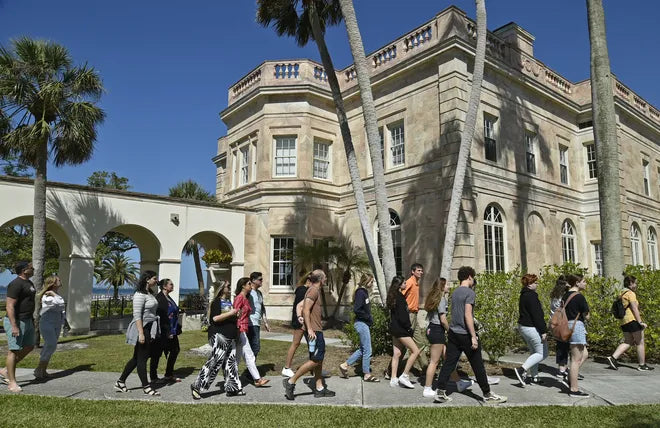

The meeting of New College of Florida’s Board of Trustees on Wednesday afternoon began with a full hour of fierce criticism from members of the community, as dozens of professors, students, and parents lambasted what they view as a hostile takeover of the institution by a Republican governor with likely presidential ambitions.
Eyal Press
New Yorker
Excerpt: In 2005, a “working definition” of antisemitism was posted on the website of the European Monitoring Centre on Racism and Xenophobia, a research institute founded by the European Union. It described antisemitism, somewhat vaguely, as “a certain perception of Jews, which may be expressed as hatred toward Jews.”
On July 23rd, Columbia reached a settlement with the Administration which required it to pay the government two hundred million dollars over the next three years and to broaden its “commitment to combating antisemitism,” in exchange for having hundreds of millions of dollars in federal grants reinstated. Ten days earlier, Columbia had incorporated the I.H.R.A. definition of antisemitism into both its anti-discrimination policies and the work of its Office of Institutional Equity.
Michael C. Bender, Alan Blinder, Michael S. Schmidt
New York Times
Excerpt: Harvard University has signaled a willingness to meet the Trump administration’s demand to spend as much as $500 million to end its dispute with the White House as talks between the two sides intensify, four people familiar with the negotiations said.
According to one of the people, Harvard is reluctant to directly pay the federal government, but negotiators are still discussing the exact financial terms. The sum sought by the government, which recently accused Harvard of civil rights violations, is more than twice as much as the $200 million fine that Columbia University said it would pay when it settled antisemitism claims with the White House last week.
David French
New York Times
Excerpt: Like many of its conservative alumni, I have a complicated relationship with Harvard. I grew up in a small town in Kentucky, where I went to public school. I attended college at a small Christian university in Nashville. I never had a thought that I could attend Harvard Law School. But friends urged me to try. When I got in, it was so shocking that it felt miraculous. I knew it would change my life — and it did. It gave me some of my closest friends, it gave me career opportunities I couldn’t previously fathom, and it kindled in me a love for constitutional law. At the same time, the school had profound problems.
The more things changed, the more they stayed the same. In the 30 years since my graduation, the school has continued to change lives, and it has maintained one of the least tolerant cultures in American higher education.

Every so often, the complexities of the world break through the orange bubble that is Princeton University. There are occasional reminders of the world outside, like the pro-Ukraine flag-waving event outside FitzRandolph Gate, reminding us that a major conflict in Europe is still ongoing four years later. Even as a veteran, it still feels like something happening in a remote place. It was only when I attended the European Cultural Studies (ECS) Faber Colloquium, a requirement for the European Studies minor I am pursuing, that I reflected on Europe’s significance and the debt Princeton as an institution owes to Europe, from its architecture to its precept system.

Filming student protesters. Emailing administrators about a newspaper launch. Asking a commentator for additional information to back up their claims. Placing a disclaimer on a letter to the editor. These basic journalistic practices are a far cry from disruption or harassment, yet student journalists nationwide have recently received notices of investigation based on each one of these acts.
These students face a fight behind the closed doors of conduct hearings, and the outcome of these battles determines how colleges and universities decide who is a journalist and what journalism on their campus can look like.

In December, UC Berkeley administrators handed down a six-month suspension without pay to Peyrin Kao, a 26-year-old computer science lecturer, after finding that he had violated university policy by making pro-Palestinian comments to students in a classroom after class and advertising that he was participating in a hunger strike.
We asked two UC Berkeley professors with opposing views, Christopher Kutz and Erwin Chemerinsky, to succinctly lay out their case in support, or in opposition, to the measure.

Yale University has finally achieved the academic version of Nirvana, a state of perfect peace and enlightenment. A recent study found that the faculty had finally purged every Republican donor from its ranks. While 98 percent of the political donations went to Democrats, not a single professor could be found who gave to a single Republican candidate. The complete lock for Democrats is in a country that is split evenly between Republicans and Democrats.
The Yale Daily News reviewed more than 7,000 Federal Election Commission filings from 2025 listing Yale as the employer: “Of 1,099 filings that included ‘professor’ in their occupation, 97.6 percent of the donations went to Democrats, while the remaining 2.4 percent went to independent candidates or groups,” the student newspaper reported Jan. 14.”
The study reinforces the recent Buckley Institute report, which found that, of the 43 departments surveyed, 27 entire departments contained zero Republican professors.

The Network of Enlightened Women works on dozens of U.S. college campuses to amplify the voices of conservative young women who are questioning progressive orthodoxies. Free Expression associate editor Mary Julia Koch spoke recently with Karin Lips, the founder and president of NeW, about her mission to support conservative women in college and in their careers, and how she’s pushing back on the left’s definition of feminism.

If you were to judge by public-opinion polling, you might reasonably conclude that Americans have broadly given up on the idea of going to college. In 2013, 70 percent of adults surveyed by Pew said that a college education was “very important.” This year, only 35 percent did. Over the same time period, the share of Americans who believe that college is “not worth the cost” rose from 40 to 63 percent, according to NBC.
If you were to judge, instead, by the choices that Americans are actually making, you might draw a different conclusion. Despite the reported skepticism of higher education, enrollment in four-year colleges and universities is growing.

There is a growth sector in American higher education. The number of “Civics Centers” has exploded in the last decade, and especially since 2021.
What are these civics centers, and what explains their proliferation now?
Heterodox Academy (HxA), the leading non-partisan higher education reform organization in the US for faculty, staff and students, championing open inquiry, viewpoint diversity and constructive disagreement, has decided to provide some answers.

At the University of North Florida, where I serve as a professor of education, I was told, along with my colleagues, to alter our syllabi to remove the terms “diversity” “equity” “inclusion” and “culture.” “It’s only three or four words,” the university administrators said. “It’s the law and we must follow the law.”
This semester, it became clear to me that Florida universities, and the faculty who teach there, are being muzzled by zealous policy makers and by over-complying administrators. These four words – “diversity,” “equity,” “inclusion,” and “culture” – have been deemed inappropriate as subjects to discuss in a college classroom at University of North Florida. This censorship is a harbinger of what’s to come: a threat to the pursuit of knowledge and academic inquiry everywhere.
Haeon Lee and Nico David-Fox
Daily Princetonian
Two-thirds of grades awarded in Princeton undergraduate coursework in the 2024–25 academic year were A-plus, A, or A-, according to a Monday report distributed to faculty, a dramatic increase over the past decade.
Dean of the College Michael Gordin briefly discussed the report at Monday’s faculty meeting, expressing concerns about grade inflation and the allocation of A-plus grades. However, Gordin noted that grading is under the jurisdiction of departments.
Associated Press/NPR
Excerpt: The Trump administration cannot fine the University of California or summarily cut the school system's federal funding over claims it allows antisemitism or other forms of discrimination, a federal judge ruled late Friday in a sharply worded decision.
Isaac Barsoum
Daily Princetonian
Excerpt: On Friday, Nov. 7, 2025, Sunrise Princeton, alongside the Princeton Progressive Coalition, organized a rally of more than 100 demonstrators. We called on the University to act as a leader by defending life-or-death climate research, divesting from weapons manufacturers to end the genocide in Palestine, protecting immigrants and international students, and safeguarding academic freedom in a time when rising authoritarianism threatens progress across the world.
As a lead organizer for this rally, I learned an important lesson: Princeton students care a lot about progressive change, and are willing to publicly display their support because they’re optimistic that their actions can make a difference on a policy level. They just feel like they’re too damn busy.
Robert Shibley
FIRE
Excerpt: This Wednesday, the Texas A&M System Board of Regents will vote on whether to give university presidents sweeping veto power over what professors can teach. Hiring professors with PhDs is meaningless if administrators are the ones deciding what gets taught.
Under the proposal, any course material or discussion related to “race or gender ideology” or “sexual orientation or gender identity” would need approval from the institution's president. Faculty would need permission to teach students about not just modern controversies, but also civil rights, the Civil War, or even ancient Greek comedies.
Catherine E.F. Previn
Harvard Crimson
Excerpt: Harvard students have gotten too comfortable.
Last week, Harvard released its report on grade inflation. Among several concerning metrics was the statistic that 60.2 percent of all grades in all courses are now solid A’s. Administrators have pledged to confront this trend, and the report offers several explanations.
But one line stood out to me above all: The College noted that one faculty member described the shift as instructors offering “emotional support” instead of “critical feedback.” This sentiment captures the cultural zeitgeist driving academic complacency: Harvard’s post-pandemic culture of well-intentioned leniency.
Amy Lai
Academe Blog
Excerpt: Academic freedom is generally defined as the freedom to engage in activities involved in the production of knowledge, without unreasonable interference or restriction from law, institutional regulations, or public pressure. Interferences with academic freedom can come from within the academy, such as in the form of institutional pressures, but may also come from hostile foreign powers that are not content with countries mutually learning from and shaping one another’s cultures and instead aggressively extend their influences in Western democracies and force democratic institutions to abide by their rules.
Len Gutkin
Chronicle of Higher Education
Excerpt: Last week, I wrote about the most recent dust-up between the American Association of University Professors (AAUP) and the Foundation for Individual Rights and Expression (FIRE), two organizations that understand their shared commitment to academic freedom in somewhat different ways. The inciting incident was a post on X in which the AAUP’s official account responded to charges of liberal bias in academe by insisting that “fascism generally doesn’t do great under peer review.”
Josh Moody
Inside Higher Ed
Excerpt: The University of Virginia has reached a settlement agreement with the Department of Justice that will pause pending investigations in exchange for assurances from the public flagship that it will not engage in unlawful practices around admissions, hiring, programming and more.
As part of the deal, UVA agreed to follow a July memo from U.S. Attorney General Pam Bondi that bars the use of race in hiring and admissions practices as well as scholarship programs. UVA will be required to provide “relevant information and data” to the DOJ, according to the news release.
Dylynn Lasky Bobby Ramkissoon
FIRE
Excerpt: After the assassination of conservative activist Charlie Kirk, universities faced a dilemma that has become grimly familiar in the age of social media: what to do when a member of the campus community says something online that others find intolerable.
Within days, institutions moved with visible urgency. Some suspended employees. Others terminated them outright. A few launched “investigations” whose conclusions seemed preordained. The message these colleges sent was unmistakable: offensive speech is not merely offensive, it is an assault on human dignity itself. And that, in the eyes of administrators, makes it punishable.
Vimal Patel
New York Times
Excerpt: M.I.T. became the first university to reject an agreement that would trade support for the Trump administration’s higher education agenda in exchange for favorable treatment.
Letitia James, William Tong, Kathy Jennings, Kwame Raoul, Keith Ellison, Matthew Platkin, Charity Clark and Nick Brown
Inside Higher Ed
Excerpt: The Supreme Court, even in striking down diversity initiatives, still made clear that universities could explore race-neutral alternatives to achieve equity. The use of socioeconomic and geographic factors is exactly such an alternative. Despite U.S. Attorney General Pamela Bondi’s recent nonbinding guidance warning against the use of geographic indicators as “proxies” for race, make no mistake: Abandoning consideration of these elements of an applicant’s background is not a legal requirement but a political choice, reflecting fear rather than courage.
George Packer
The Atlantic
Excerpt: Kirk was killed on a college campus in Utah, seated under a tent with the slogan “Prove Me Wrong,” facing a crowd of several thousand people, debating anyone who wanted to approach and challenge him. He kept up this practice—part recruitment, part provocation, part entertainment—throughout his years as Turning Point USA’s leader.
He was using his freedom of speech, and if his style was aggressive, divisive, sometimes mocking, losing his life this way was no less an assault on everything that democracy’s remaining believers should hold dear. Those who disagreed with Kirk ought to be able to deplore what he stood for and also the violence that killed him.
Tyler Austin Harper
The Atlantic
Excerpt: Since the release of ChatGPT, in 2022, colleges and universities have been engaged in an experiment to discover whether artificially intelligent chatbots and the liberal-arts tradition can coexist. Notwithstanding a few exceptions, by now the answer is clear: They cannot. AI-enabled cheating is pretty much everywhere. As a May New York magazine essay put it, “students at large state schools, the Ivies, liberal-arts schools in New England, universities abroad, professional schools, and community colleges are relying on AI to ease their way through every facet of their education.”
University of Austin, Substack
Excerpt: Two hundred and fifty years ago this week, King George III formally declared Americans to be rebels and traitors. This dashed the colonists’ hopes for a peaceful reconciliation. And set the path to declare a new nation based on the proposition that all men are created equal. But on the heels of America’s quarter-millennium since the Declaration of Independence, I want to do something a bit unfashionable: I want to defend inequality.
Of course, all men are created equal. But all men are not the same. We have unequal curiosity, unequal intellect, unequal talent, unequal courage, unequal drive, unequal achievement. I want to defend this kind of inequality because I believe it is the most important way that UATX distinguishes itself. And because being honest about inequality is the most important way that UATX can help you be extraordinary.
Rose Horowitch
The Atlantic
Excerpt: Even before the Ivy League upheavals of the past two years, Jewish students had been slowly drifting away from the elite campuses of the Northeast. Now, as some seek respite from the protest movement that erupted after the Israeli response to the October 7, 2023, Hamas invasion of southern Israel, the drift has become more like—sorry—an exodus. And selective colleges outside the Northeast, sensing an intensifying disdain for Ivy League schools among Jewish teens and their parents, are tripping over one another to recruit these students.
Sarah McLaughlin
The Next Move, Substack
Excerpt: For years, I’ve been sounding the alarm about foreign authoritarians’ pernicious influence on higher education in America and other countries. Especially concerning are the Chinese government’s efforts, which have harmed students and academics and incentivized universities to put their core values on the backburner.
But now, the call is coming from inside the house, too. Over the past six months, the Trump administration has undertaken efforts, ranging from illiberal to blatantly unconstitutional, to exact punishment on students, academics, and the universities they attend.
Ben Austen
New York Times
Excerpt: Since January, the Trump administration has waged war on the nation’s wealthiest and most prestigious universities, freezing billions of dollars in research grants to Harvard and blasting away at Columbia’s institutional autonomy.
But collateral damage from these attacks has engulfed schools of all types, including the country’s 1,100 community colleges, which educate about 6.4 million undergraduates each year — roughly 40 percent of the national total and more than twice as many as are enrolled at every highly selective college and university in the country combined.
Nico David-Fox
Daily Princetonian
Excerpt: After an extraordinarily tumultuous semester for higher education, Princeton concluded its fundraising year on Monday with $68.4 million in Annual Giving contributions and a 43.9 percent undergraduate alumni participation rate — the lowest rate since the 2010–11 fundraising year. The final months of year’s campaign coincided with the University’s “Stand Up” initiative, launched in April to combat the Trump administration’s attacks on higher education over the past few months.
In “Stand Up” emails to more than 10,000 alumni and other supporters, Princeton explicitly appealed for donations to Annual Giving, especially in the wake of the suspension of $210 million in federal research grants.
Grace Little
Cavalier Daily
Excerpt: The Board of Visitors will soon begin the process of selecting an interim president and conducting a national search for a new president in the wake of former University President Jim Ryan’s resignation which came under pressure from the Department of Justice. As the Board searches for a new president, viewpoint diversity is likely to be a topic on their mind.
Erin Shaw
Free the Inquiry
Excerpt: In National Institutes of Health (NIH) Director Dr. Jay Bhattacharya’s recent interview with Andrew Huberman, Bhattacharya offers criticism of current biomedical research models, an optimistic view of the future of the NIH, and a scathing review of academic freedom at Stanford. The lengthy interview is a worthwhile listen for heterodox thinkers, but if you haven’t got four hours to spare, we bring you a few key takeaways.
Liam Knox
Inside Higher Ed
Excerpt: The U.S. State Department is rolling out sweeping new rules for vetting student visa applicants using their social media presence, according to Politico. The new process will include screening for “any indications of hostility towards the citizens, culture, government, institutions or founding principles of the United States,” according to an internal State Department cable.
Department officials will also look for posts that signal “advocacy for, aid or support for foreign terrorists and other threats to national security” and “support for antisemitic harassment or violence,” specifically citing support for Hamas—a charge commonly levied against student protesters advocating for Palestinian rights—as grounds for rejection. The cable also directs officials to cull applicants who “demonstrate a history of political activism.”
Thomas B. Edsall
New York Times
Excerpt: Gregory Conti, a political scientist at Princeton, is not a left-wing academic. He is a senior fellow at the conservative Manhattan Institute and the editor at large of Compact, a heterodox online magazine that leans to the right. In the case of Trump v. Harvard, Conti wrote in Compact, the university “is close to being an appendage of the Democratic Party.”
Despite Conti’s indisputably conservative credentials, he has come to believe that the Trump administration’s approach to higher education — and toward Harvard in particular — not only violates due process but also threatens to destroy the reputation of the United States as an international center of learning.
By Danielle Shapiro
Princeton’s President Christopher Eisgruber has positioned himself as perhaps the leading academic defender against the Trump administration’s crackdown on universities, citing the importance of universities and academic freedom, as well as his belief that the administration has greatly overreached in its attacks, especially against Harvard.
Yet his ability to lead credibly this defense was challenged in April by an event at Princeton featuring former Israeli Prime Minister Naftali Bennett, who is considered one of the favorites to succeed Benjamin Netanyahu next year. Demonstrators inside McCosh Hall shouted Bennett down and a fire alarm was pulled, apparently by a protester, ending the event. Outside, Jewish attendees were called “inbred swine,” among other slurs, and told to “go back to Europe.” President Eisgruber apologized to Bennett and university officials promised a serious investigation. A number of observers noted the importance of Princeton enforcing its rules in this situation. I attended the April 7 event, and I volunteered to speak as a witness to university investigators, with whom I met twice for over two hours.
James Bacon
The Jefferson Council
Excerpt: “Conservative students at the University of Virginia,” a fourth-year student once confided to me, “know who all the conservative professors are. … All seven of them.”
That was only a slight exaggeration. Through my work with the Jefferson Council I have identified a dozen faculty members openly identifying as conservative and/or libertarian out of roughly 1,700 faculty members. I have met three or four more not yet willing to come out of hiding.
Alice Speri
The Guardian
Excerpt: Parker Hovis was four courses away from getting his computer science degree from the University of Florida when he was arrested along with several other students at a pro-Palestinian protest on campus last spring. While the charges against him were dismissed and a school conduct committee recommended only minor punishment – a form of probation – the university administration suspended him for three years. He’ll be required to reapply if he wants to come back after that.
Hovis, who has since left Florida and is working to pay off his student loans despite never graduating, is one of more than 1,000 students or student groups that were targeted by their universities for punishment between 2020 and 2024 over their speech, according to a report published today by the Foundation for Individual Rights and Expression (Fire). About 63% of them were ultimately punished.
Tal Fortgang
Commentary
Excerpt: Intersectionality is in crisis. It is reeling from the Republican-led assault on left-wing radicalism, retreating to its campus redoubt. If it passes from our public discourse, its epitaph should read: “Often wrong, never in doubt.”
Triumphalism is premature, though. During its brief, wondrous heyday as a progressive shibboleth, intersectionality exerted enormous power over American life. Intersectional ideas fueled BLM, the Women’s March, and gender ideology, all of which blended into one “omnicause.” It is on the decline, but the underlying ideas that ignited it in the first place may persist. Ensuring that intersectionality dies and stays dead requires understanding those ideas and developing the vocabulary to explain why the movement that intersectionality spawned inevitably fails.
Nicholas H. Wolfinger
Unsafe Science
Excerpt: “A new McCarthyism has descended on higher education”
If I had a dollar every time I read that phrase, I could afford to endow a chair in McCarthy studies. Centrists and conservatives used it a lot during the Great Awokening of the 2010s. Progressives got their turn after the October 7 Hamas attack. And, of course, the second Trump presidency and its assault on higher education has been manna for the McCarthyism-pronouncers. None of these folks are wrong, except perhaps for their reliance on a tired trope.
Brooke Lober, Eli Meyerhoff, and Emily Schneider
Academe Blog
Excerpt: The climate on American university campuses is dangerous. Administrators ban protests for Palestinian rights. Immigration and Customs Enforcement snatches students off the streets. The Trump administration revokes hundreds of millions of dollars in funding for research. And all this is done in the name of protecting Jewish students against a so-called culture of antisemitism.
Last April, Claire Shipman, the current acting president of Columbia University, told a congressional committee the university had a “specific problem . . . rampant antisemitism.” If that claim were true, it would constitute a crisis. But it’s not true. Instead, Trump and the Right are weaponizing false claims of antisemitism to attack pro-Palestinian protesters, and they’re using this lie as a smokescreen for destroying higher education and other public goods.