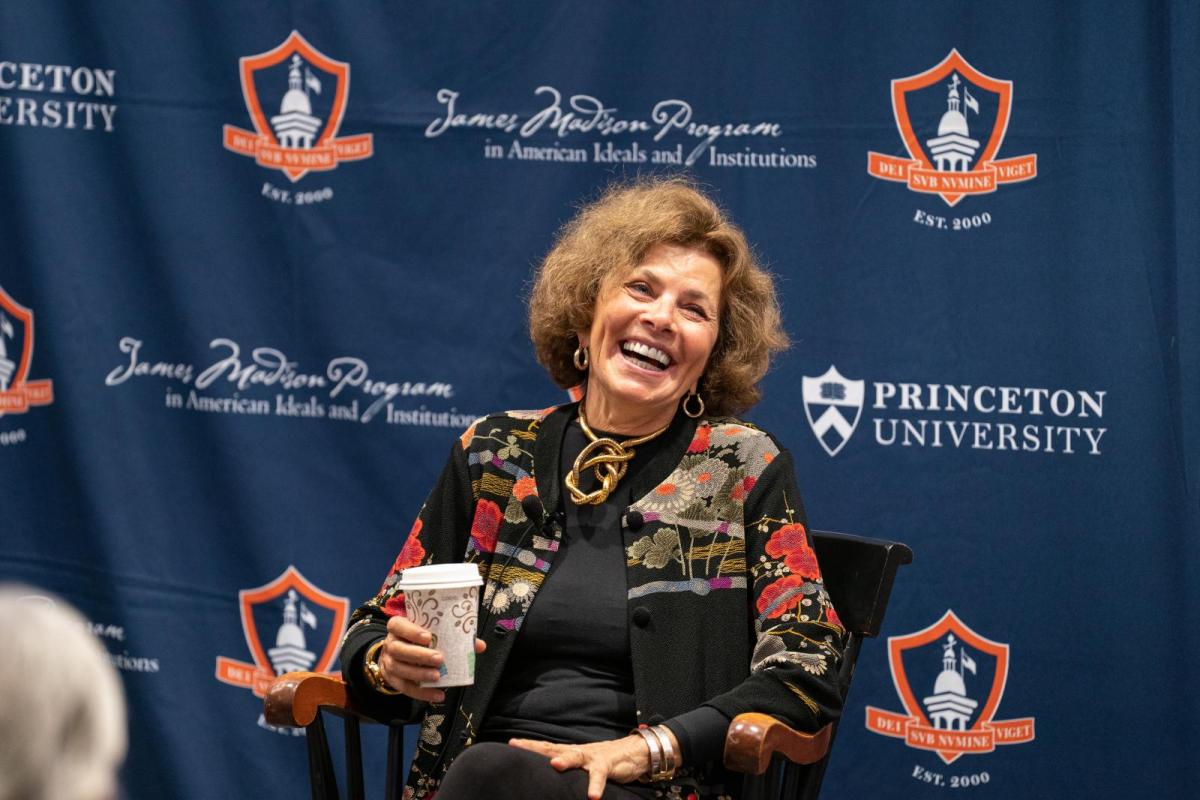

On Sunday, May 24, Princetonians for Free Speech (PFS) hosted a breakfast at the Nassau Inn — and despite dreary skies outside, the energy inside couldn't have been brighter. About 70 alumni, current students and other free speech supporters turned out for what proved to be an engaging and inspiring morning.
PFS leadership set the stage with organizational updates from Co-founder Ed Yingling '70, President & CEO Todd Rulon-Miller '73, and Executive Director Angela Smith — including the exciting news that PFS has grown to over 26,000 email subscribers (20,000 of whom are Princeton alumni). This represents remarkable growth from just 1,400 two years ago, showing a momentum that was on full display during this packed event.
Gabe Levin
The Nation
Excerpt: Dr. Eric Cheyfitz, a professor of American studies at Cornell, said the university has canceled the two classes he was set to teach this semester. It comes as the provost is recommending that he be suspended for two semesters without pay on the grounds that he violated federal antidiscrimination laws, The Nation has learned.
Cheyfitz’s lawyer, Luna Droubi, said it’s the latest turn in months of investigations—carried out by different university bodies—into whether Cheyfitz, 84, told a graduate student last semester to drop a class he was teaching about Gaza because the student is Israeli. Cheyfitz, who is Jewish and whose daughter and grandchildren live in Israel, denies the allegation.
Andrea Brower
Common Dreams
Excerpt: For months before U.S. President Donald Trump took office, nearly daily reports rolled in of students and professors on trial for their activism for Palestinian life.
The number of the similar cases is impossible to know, due in part to near media omission. Many people who have faced or are currently facing investigations are instructed that they must remain silent (and isolated) as to not “compromise” the investigation. Some are quiet because their jobs, prospects for future employment, and safety are at stake. What is clear is that the trials are wide-reaching, extraordinarily punitive, largely coordinated, and were coming down rapidly across the country at educational institutions of all types even before Trump was sworn in.
Josh Moody
Inside Higher Ed
Excerpt: Former University of Virginia president Jim Ryan has broken his silence concerning his abrupt resignation, accusing the Board of Visitors of dishonesty and complicity in his ouster, which came amid federal government scrutiny over the university’s diversity, equity and inclusion practices.
Judith Butler
Chronicle of Higher Education
Excerpt: On September 4, I received an email from the University of California at Berkeley’s chief legal counsel, David Robinson, informing me that my name has been handed over to the Trump administration in a file containing allegations of antisemitism.
A few days later, I discovered that the university had sent a list of 160 names to the Department of Education’s Office for Civil Rights. The list includes the names of students, staff, and faculty who may well suffer serious consequences, including the loss of jobs, expulsion, deportation, or harassment. This was a shock for many of us who believed that Berkeley is a university where one can expect support for freedom of expression and guarantees of fair procedure.
Jaweed Kaleem and Michael Wilner
LA Times
Excerpt: Hours after the Trump administration demanded that the University of California pay a $1-billion fine to settle federal accusations of antisemitism in exchange for restoring frozen grant funding to UCLA, Gov. Gavin Newsom called the proposal “extortion” and said the state will go to court to protect the nation’s premier university system.
President Trump is “trying to silence academic freedom” by “attacking one of the most important public institutions in the United States of America,” Newsom said, adding that he would “stand tall and push back against that, and I believe every member of California Legislature feels the same way.”

By Ethan Hicks ‘26
On Tuesday, March 21, Professor Robert P. George, McCormick Professor of Jurisprudence at Princeton, and Nadine Strossen, former president of the ACLU, sat down to discuss the history and modern state of free speech in America in their joint talk “Civil Liberties: On Campus and Beyond.”
By Leslie Spencer ’79
A group of Princeton faculty have come together to create The Princeton Council on Academic Freedom. It mirrors the new faculty groups at peer institutions, like the academic freedom councils at Harvard and Columbia, Faculty for Yale, and the University of Pennsylvania’s Vision for a New Future.
by Stuart Taylor Jr. & Edward Yingling
National Review
Excerpt: Princeton University is tiptoeing toward canceling its greatest president and a founder of our nation in a process that its trustees and president Christopher Eisgruber accelerated on October 2 by announcing that they would leave the statue of John Witherspoon in its prominent place on Firestone Plaza — but probably only for now. The issue has been punted to the “Campus Art Steering Committee” to decide whether the statue should be moved, or removed.
by Edward Yingling
Real Clear Politics
Results of a new survey of Princeton students sponsored by PFS has just been released. Today Real Clear Politics published an article by PFS co-founder Ed Yingling that highlights the survey’s key findings
Elyse C. Goncalves and Akshaya Ravi
Harvard Crimson
Excerpt: Harvard Medical School canceled a planned Jan. 21 lecture on wartime healthcare and a subsequent panel with patients from Gaza receiving care in Boston in response to objections that students would hear from Gazans impacted by the war and not also Israelis.
Course instructors and students were notified Tuesday morning that the events — scheduled for that evening — would not be held. Medical School Dean George Q. Daley ’82 wrote in a Wednesday email sent to first-year students and obtained by The Crimson that his office began receiving complaints from students and faculty within days after the session was first publicized last week.
Ava Johnson
Daily Princetonian
In his recently released book “Terms of Respect,” Princeton University President Christopher Eisgruber ’83 presents a strong defense of free speech on college campuses. He locates the roots of contemporary free speech doctrine in the Civil Rights Era and ultimately concludes that “students are getting free speech right.”
This is a commendable analysis consistent with Eisgruber’s public defenses of student speech. But his framework is often unfairly paternalistic.
Michael Hurley
FIRE
Excerpt: Over the past several years, some politicians have tried to ban or limit discussion of controversial ideas in higher education, particularly those related to critical race theory, gender identity, and diversity, equity, and inclusion. FIRE has been on the front lines of this fight, opposing bills that target classroom speech and challenging those that become law.
Perhaps in part because of this roadblock, some actors have taken a more indirect approach to removing disfavored ideas from the classroom: a mix of “anti-woke” laws and cancel culture designed to intimidate schools into doing what the state cannot do directly.
Angel Eduardo
FIRE
Excerpt: If you’re a believer in free speech, the past two weeks have been one of the longest years of your life. In fact, this might have been the worst fortnight for free expression in recent memory.
The difference between words and violence – and the civilizational importance of free speech – couldn’t have been more stark in that moment. No matter how hurtful, hateful or wrong, there is no comparing words to a bullet. To preserve that distinction, we must have the highest possible tolerance for even the ugliest speech. But that notion has landed on largely deaf ears, because what followed was a cacophony of cancellations.
Rose Horowitch
The Atlantic
Excerpt: No one would be surprised to learn that an elite university has a plan to counteract the structural barriers to the advancement of a minority group. Johns Hopkins University’s latest diversity initiative, however, has managed to put a new spin on a familiar concept: The minority group in question is conservative professors.
Several elite red-state public universities have recently established academic centers designed to attract conservative scholars. And institutions that haven’t sought out conservative faculty may soon find new reasons to do so. The Trump administration has demanded that Harvard hire additional conservative professors or risk losing even more of its federal funding.
Jonathan Turley
Jonathan Turley’s Blog
Excerpt: Three-fourths of Princeton students told one survey that they believed it was appropriate to shout down or deplatform speakers with opposing views. That mistaken view of shout-downs as a form of free speech is obviously still prevalent on campus after a group of protesters stopped a discussion with former Israeli Prime Minister Naftali Bennett. The question is whether Princeton will do anything about it or whether, when it comes to free speech, it will prove to be a mere paper tiger.
Princetonians for Free Speech have struggled to restore free speech on campus and they have had some success. However, this is an obvious test of that commitment. While some protesters wore masks, most did not. Any students who went inside the event to prevent Bennett from being heard should be suspended. Any faculty involved in such action should be terminated.
Julie Bonette
Princeton Alumni Weekly
Excerpt: Thirteen pro-Palestinian protesters are set to head to trial to face trespassing charges in municipal court on April 14, almost exactly one year after occupying Clio Hall last spring.
The trial, which is expected to last three days, was scheduled at a virtual hearing on Jan. 14, after it became clear that the parties could not agree on a proposed plea deal.
Christa Dutton
Chronicle of Higher Education
Excerpt: Pro-Palestinian protests at three colleges in the past several days led to more than 100 arrests for trespassing or destruction of property. Several students were also suspended for violating their college’s policies and protest restrictions.
The mass arrests at Columbia University, Swarthmore College, and the University of Washington may signal a shift in how college leaders are responding to protests, experts say. Since last spring’s widespread protests over the war in Gaza, college leaders have drawn fierce criticism for being too slow to dismantle disruptive encampments or call in police to arrest those violating the law. Now, they’re eager to show federal authorities that they’re serious about stopping antisemitism and unruly protests.