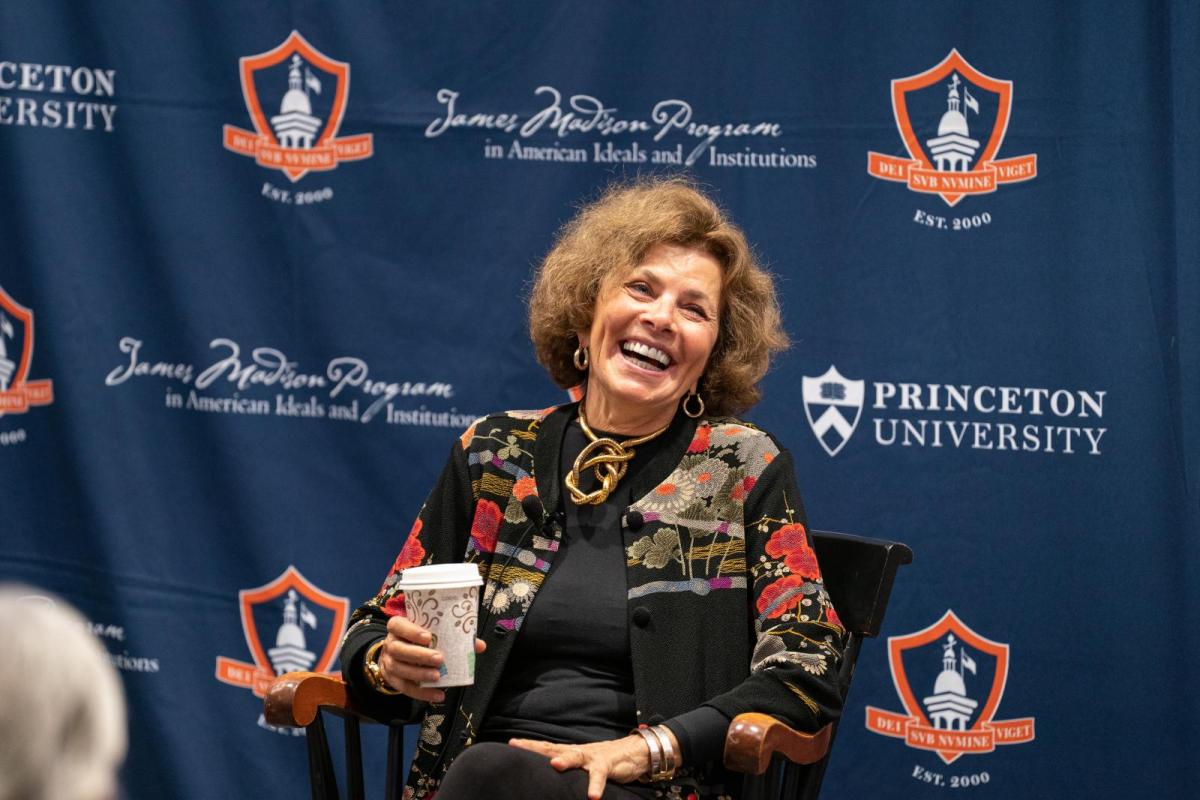

On Sunday, May 24, Princetonians for Free Speech (PFS) hosted a breakfast at the Nassau Inn — and despite dreary skies outside, the energy inside couldn't have been brighter. About 70 alumni, current students and other free speech supporters turned out for what proved to be an engaging and inspiring morning.
PFS leadership set the stage with organizational updates from Co-founder Ed Yingling '70, President & CEO Todd Rulon-Miller '73, and Executive Director Angela Smith — including the exciting news that PFS has grown to over 26,000 email subscribers (20,000 of whom are Princeton alumni). This represents remarkable growth from just 1,400 two years ago, showing a momentum that was on full display during this packed event.
Alice Dreger
Free the Inquiry, Heterodox Academy
Excerpt: Add Northwestern and Cornell to the growing list of universities whose federal funding is being threatened because of alleged failure to appropriately manage antisemitism on those campuses.
To help our readers understand what’s going on — and why it is legally questionable and a problem for open inquiry — I asked Heterodox Academy (HxA) Director of Policy Joe Cohn to answer some questions about this scene.
Josh Moody
Inside Higher Ed
Excerpt: Former University of Virginia president Jim Ryan has broken his silence concerning his abrupt resignation, accusing the Board of Visitors of dishonesty and complicity in his ouster, which came amid federal government scrutiny over the university’s diversity, equity and inclusion practices.
Judith Butler
Chronicle of Higher Education
Excerpt: On September 4, I received an email from the University of California at Berkeley’s chief legal counsel, David Robinson, informing me that my name has been handed over to the Trump administration in a file containing allegations of antisemitism.
A few days later, I discovered that the university had sent a list of 160 names to the Department of Education’s Office for Civil Rights. The list includes the names of students, staff, and faculty who may well suffer serious consequences, including the loss of jobs, expulsion, deportation, or harassment. This was a shock for many of us who believed that Berkeley is a university where one can expect support for freedom of expression and guarantees of fair procedure.
Jaweed Kaleem and Michael Wilner
LA Times
Excerpt: Hours after the Trump administration demanded that the University of California pay a $1-billion fine to settle federal accusations of antisemitism in exchange for restoring frozen grant funding to UCLA, Gov. Gavin Newsom called the proposal “extortion” and said the state will go to court to protect the nation’s premier university system.
President Trump is “trying to silence academic freedom” by “attacking one of the most important public institutions in the United States of America,” Newsom said, adding that he would “stand tall and push back against that, and I believe every member of California Legislature feels the same way.”

By Ethan Hicks ‘26
On Tuesday, March 21, Professor Robert P. George, McCormick Professor of Jurisprudence at Princeton, and Nadine Strossen, former president of the ACLU, sat down to discuss the history and modern state of free speech in America in their joint talk “Civil Liberties: On Campus and Beyond.”
Christopher Bao and Cynthia Torres
Daily Princetonian
Excerpt: The Trump administration has suspended several dozen research grants to Princeton, University President Christopher Eisgruber ’83 wrote in a campus-wide email on Tuesday. The grants were issued from several federal agencies, including the Department of Energy, NASA, and the Defense Department.
The exact amount in question and the reasoning for the pause itself are unclear, and Eisgruber acknowledged only the latter in his statement. But the Daily Caller, a right-wing news organization, reported last night that the government would halt $210 million in federal funding to Princeton due to an ongoing investigation of antisemitism on campus, citing an anonymous Trump official.

The U.S. Department of Education will continue to target diversity, equity and inclusion programs in colleges and schools under Title VI despite a court block on its controversial anti-DEI Dear Colleague letter.
That letter, issued a year ago, announced the department’s policy interpreting Title VI — which protects students from discrimination based on race, ethnicity and national origin — to prohibit DEI programs. It said some college and schools’ race-based equity programs discriminate against White and Asian students and could result in federal funding loss.

Princeton President Christopher Eisgruber made his name in the academy as a constitutional law professor. Since he is now the president of a pacesetting Ivy League institution, he is also at the forefront of the free-speech wars. It’s understandable, given those two pieces of information, that Eisgruber would seek to enlighten readers of Terms of Respect by analyzing the relationship between constitutional law—particularly the First Amendment’s protection of the freedom of speech--and campus speech-related controversies. It’s expected, even.
Yet Eisgruber manages to surprise his readers with his understanding of the relationship between the law of speech and contemporary controversies. The First Amendment was ratified in 1791, but Eisgruber takes his cues from the 1960s. “The American doctrine of free speech as we know it today emerged in the 1960s,” he writes. “Until 1964, the United States Supreme Court had a lackluster track record in free speech cases.” It was then that the Court decided New York Times v. Sullivan, a First Amendment case that shows, in Eisgruber’s view, “the important historical and conceptual links between free speech and the American struggle for racial equality.”
Peter Berkowitz
RealClearPolitics
Excerpt: As with many things Trump, the administration’s “Compact for Academic Excellence in Higher Education” provoked accusations of authoritarian takeover of vital American institutions. And, as with many things Trump, the administration’s compact overreached in pursuit of a worthy goal, giving critics ammunition to oppose urgently needed reform.
By Joseph Gonzalez ‘28
On Friday, September 5th, in McCosh 28 lecture hall on Princeton’s campus, Robert Corn-Revere presented “From Anthony Comstock to South Park: America and The Culture of Free Expression,” hosted by the Princeton Open Campus Coalition (POCC). Mr. Corn-Revere was affable when caught before or after the lecture, sharing stories about his friendship with comedian/magician Penn Jillette, or the behind-the-scenes stories of working on either side of the FCC’s crusade on obscenity. Mr. Corn-Revere, now chief counsel to the Foundation for Individual Rights and Expression (FIRE), has been on the frontlines of free speech battles for four decades as a First Amendment litigator. His good-natured laugh, warm smile, and light-hearted demeanor mask a firebrand when it comes to free expression advocacy, in the spirit of a quote often attributed to Voltaire: “I disapprove of what you say, but I will defend to the death your right to say it.”
Kevin Carey
The Atlantic
Excerpt: In March 2019, a team of investigators from the U.S. Department of Education’s fraud-prevention team arrived at a Houston trade school for what was supposed to be a routine inspection. Several of the students the team wanted to interview, however, were nowhere to be found. At the end of a long and frustrating day, the investigators headed back to their car. That’s when two of the missing students appeared in the parking lot. They wanted to talk in a place where school administrators couldn’t overhear them.
Tal Fortgang
Manhattan Institute
Excerpt: No one can pinpoint when the fight against diversity, equity, and inclusion started – if it can even be disentangled from related campaigns against affirmative action, minority contracting, and other forms of identity favoritism – but it’s hardly a nascent movement by now. The Supreme Court has ruled that affirmative action, as long practiced in higher education, is illegal. The Trump administration is rooting out racial favoritism in government programs and contracting alongside states that are foregrounding merit in all public investments.
However, to achieve its goals and maintain its victories, the anti-DEI movement must entrench its competing set of principles in non-governmental institutions – and ultimately in Americans’ hearts and minds.
Nitasha Tiku
Washington Post
Excerpt: Influential tech investor and Trump adviser Marc Andreessen recently said universities will “pay the price” for promoting diversity and allegedly discriminating against supporters of President Donald Trump, according to messages he sent to a group chat with White House officials and technology leaders reviewed by The Washington Post.
The billionaire’s messages also cited Massachusetts Institute of Technology and Stanford University, a respected institution at the heart of Silicon Valley that has incubated tech companies such as Google. Andreessen and his wife have donated millions of dollars to the school.
Tal Fortgang ‘17
With President Eisgruber personally leading the academic “resistance” against the Trump administration’s attack on elite universities, Princeton launched a campaign, announced in the Daily Princetonian on May 2, that “encourages alumni, faculty, students, and friends to make their voices heard in support of higher education during this challenging period.” Stand Up for Princeton and Higher Education aims to deputize a cadre of the most influential Americans – Princetonians themselves – who tend to have strong nostalgia for their alma mater, not merely to pay it forward to future Princetonians through donations but to become a kind of political force defending the university in Washington.
By Khoa Sands ‘26
The second Trump administration's attack on higher education has reinvigorated conversations around academic freedom. Concerns once relegated to the center and the right have been taken up again by the left with newfound salience. Princeton, thankfully, has managed to escape the worst of the madness, despite some major cuts to research funding. This relatively privileged situation has not stopped Princetonians from debating, discussing, and defending academic freedom at Princeton.
Stuart Taylor Jr., president of "Princetonians for Free Speech" and an RCP contributor, joined Tom Bevan, Friday on the RealClearPolitics podcast, to talk about the Trump administration’s decision to suspend hundreds of millions of dollars in grants to Princeton.They discuss this piece by Christopher Rufo and Ryan Thorpe in City Journal: "Princeton’s War on Civil Rights".
September 18, 2023
Dear President Eisgruber and Board of Trustees:
With the beginning of a new school year at Princeton, we are writing to you on behalf of Princetonians for Free Speech (PFS) to reiterate our strong support for Princeton becoming a leader on free speech and academic freedom issues and to inform you of our efforts to assist in achieving that goal.
Ross Marchand
FIRE
Excerpt: Great news: UConn School of Medicine administrators are going scalpels down on the school’s attempt to forcibly transplant politics and ideology into its incoming student body.
In 2022, UConn finalized its own version of the Hippocratic Oath, which includes a promise to “actively support policies that promote social justice and specifically work to dismantle policies that perpetuate inequities, exclusion, discrimination and racism.” Most recently, UConn required the incoming class of 2028 to pledge allegiance not simply to patient care, but to support diversity, equity, and inclusion.
Conor Friedersdorf
The Atlantic
Excerpt: On President Donald Trump’s first day back in the White House, he issued an executive order ending diversity, equity, and inclusion in the federal government. Its sweeping language forbids DEI “mandates, policies, programs, preferences, and activities,” and orders the termination of all DEI positions—hundreds if not thousands of roles. Trump and his allies are also trying to curtail DEI in corporations that contract with the state, colleges that get federal funds, and more.
The ambition of these anti-DEI efforts mirrors the earlier, heavy-handed push, including by the Biden administration, to embed DEI practices into almost all of America’s most important institutions. It also underscores just how widely and variably the term DEI is now used across society.
Julian Mark
New York Times
Excerpt: A coalition of professors, diversity officers and restaurant worker advocates filed a federal lawsuit Monday in a bid to block President Donald Trump’s executive orders that target diversity, equity and inclusion (DEI) in the U.S. government, the private sector and academia, alleging that he exceeded his authority in issuing them.
Sara Weissman
Inside Higher Ed
Excerpt: "Chaos is the goal,” Mike Gavin, president of Delta College in Michigan, told a Zoom room full of higher ed professionals on a January afternoon. “These external forces are trying to cause chaos to distract us from our mission.”
By “chaos” he meant the onslaught of anti-DEI legislation sweeping the country—state laws requiring universities to scrub diversity statements from their hiring processes, identify DEI-related courses and programs for scrutiny, and cut personnel, centers and offices dedicated to supporting underrepresented student groups.
This article by PFS co-founder Stuart Taylor, Jr. recounts the controversy surrounding the Witherspoon statue located on Firestone Plaza. The attempted cancellation of Witherspoon and what it means for academic freedom at Princeton has been a focus of our attention, as you can see in our just-published Annual Report HERE. If you like what we are doing, please consider a year-end donation to PFS HERE.
The University’s official proceedings on the petition by assorted students and faculty members to remove from its prominent setting on Firestone Plaza the bronze statue of Princeton’s greatest president, John Witherspoon, are looking bleak for the statue, for the memory of Witherspoon, and perhaps also that of other founders of the United States.
The second and apparently final symposium on the statue, held on November 3 by the University’s Committee on Naming, was notable for the absence of any unambiguous statement by any of the five invited speakers or by the moderator, Associate Professor Beth Lew-Williams, that the statue should be left standing undisturbed where it was placed in 2001, with the strong support of respected then-President Harold Shapiro.
Edward Yingling and Stuart Taylor
RealClear Politics
Jun 20, 2023
Excerpt: The lists of “top colleges” have varied little in many years. They always include the Ivies, Stanford, MIT, Cal Tech, etc. But that could change. Colleges of all types can differentiate themselves on the core values of free speech and academic freedom, and those that do will increasingly attract more and better students, faculty, and employment opportunities for their graduates.

by Michael Poliakoff, Forbes Magazine
In the current legislative session, five state legislatures will review bills that seek to limit or abolish offices on public university campuses known by the catch-all acronym “DEI.”
By Edward Yingling and Stuart Taylor, Jr.
Founders of Princetonians for Free Speech
Princeton has now fired Classics Professor Joshua Katz. Princeton President Christopher Eisgruber recommended the highly unusual step of firing a tenured professor to the Princeton Board of Trustees, which, since it is nothing but a rubber stamp, agreed.