
The academic year is at an end, but two major studies are keeping higher education in the spotlight:
New FIRE study finds narrowing range of political views among faculty donors
The study finds that donations to political candidates from faculty at top universities have become increasingly one-sided, with the range of opinion becoming concentrated on the left.
PFS’s response, How does Princeton Compare? explains Princeton’s ranking of 13 out of the 55 university faculties studied.
The second study, drily entitled “Report on the State of Scholarship in the Humanities and the Humanistic Social Sciences” has set off a firestorm of reaction among humanities faculty and professional organizations such as the American Association of University Professors (AAUP).

The good news is that the percentage of colleges and universities earning FIRE's "red light" (bad) rating has reached a low of 13 percent — a 55 percent drop since the "Spotlight" report began in 2006, and a 1.5 percent drop from last year. The bad news is that Princeton is among that 13 percent. Princeton is still found to maintain policies that "clearly and substantially" restrict free expression.
Princetonians for Free Speech
Since the terrorist attack on Israel and the invasion of Gaza, several universities have been prominently featured in the national news for protests, sometimes violent, on their campuses and for antisemitic acts. Princeton had protests and instances of antisemitism, but these were nowhere near the level of what occurred at some schools, such as Columbia and Harvard. At PFS, we believe this was in part because Princeton set forth clear standards in advance for protests on campus. It should have come as no surprise that two of the first schools the Trump Administration went after to freeze grants were Columbia and Harvard.
A group of Princeton faculty, supported by students and alumni, have developed a statement "condemning the anti-Israel and, in many cases, antisemitic demonstrations and encampments plaguing college campuses...." Signatures are being collected for the statement from Princeton and across the country. This list of signers is growing rapidly. Among the signers are Princeton Professors Robert George, Sergiu Klainerman, and John Londregan; faculty from USC and Chicago, and Princetonians for Free Speech co-founders Stuart Taylor, Jr. and Edward Yingling.
To sign, click here.

In having a truly diverse group of students share their perspectives, Princeton makes known that there exists a home for every viewpoint. However, as much as I believe this claim to be true, there are unfortunately those who do not. It is easy to dismiss the Princeton administration and culture as entirely polarizing and ideologically biased. In fact, it is true that many here hold the same dominant perspective . But to focus on this fact alone, to rest our entire judgement on one such observation, runs the dangerous risk of neglecting the clear and persistent efforts of this University to encourage every student—even the conservative ones—to share the beliefs that he or she so earnestly pursues.

Are some schools better at fostering intellectual diversity than others? The study clearly reveals that the most elite universities are among those with the least ideological diversity. Princeton is ranked 13 out of the 55 in the study, with its faculty slightly more ideologically diverse than, for instance, UC Berkeley, Brown, Dartmouth and Harvard, and slightly less diverse than Stanford, Cornell, UCLA or Georgetown.
There is little doubt that this study provides another opening for politicians and critics to attack higher education, perhaps in unfair ways. Princeton could help neutralize this by joining those reform-minded university leaders in the now burgeoning effort to regain the public’s trust in higher education.
Princetonians for Free Speech
Excerpt: Dear Princeton Class of ’29:
This letter comes to you from the alumni organization, Princetonians for Free Speech (PFS). We have existed since you started high school four years ago. We were founded in response to a growing concern that Princeton has drifted from its core mission of the pursuit of knowledge and truth, and towards a narrow activism that threatens free speech, academic freedom, and viewpoint diversity.
Sena Chang
Daily Princetonian
Excerpt: Antisemitic graffiti of a gray swastika was found on the wall of a graduate student apartment building inside the Lakeside housing complex in mid-July. The graffiti was removed immediately following multiple reports, with the Department of Public Safety (DPS) opening an investigation into the incident and increasing foot patrols in the area in response, according to University spokesperson Jennifer Morrill.
Construction was underway inside Lakeside at the time of the incident, and the University has not yet determined whether the graffiti was the work of a student or contractor. No suspects have been named.
Seth Mandel
Commentary
Excerpt: David Piegaro fell down the stairs outside a Princeton University building and rolled painfully to the bottom. That’s when he was handcuffed and put under arrest for aggravated assault. The supposed victim was Kenneth Strother, the university’s head of security—who had, according to video of the incident and witness testimony—caused Piegaro to fall down those stairs. Strother was unharmed. Piegaro faced jail time.
On Tuesday, Piegaro was acquitted. On Thursday, Princeton revealed it still had some salt to pour into Piegaro’s wounds. The university honored Strother with its President’s Achievement Award for his “commitment to excellence and exceptional performance.”

“When it comes to getting free speech right,” writes Princeton University President Christopher Eisgruber in the introduction to Terms of Respect, “America’s young people deserve higher marks than they get.” This is a central contention of Eisgruber’s new book, and it is, as those young people say, big – if true.
It also begs the question twice over, in the way that is all but inevitable when we talk about higher education and speech, two goods contemporarily treated as goods of themselves, if not the highest goods. Whether Eisgruber’s contention is correct depends on what is meant by free speech, then again on what is meant by getting it right.

For the first time since the 2024 “Gaza Solidarity Encampment” at Princeton, Yuval Donio Gideon, head of the Public Diplomacy Department of the Consulate General of Israel in New York, met with University administrators and campus rabbis to discuss the experience of Israeli and Jewish students on campus.
Gideon met with Vice President for Communications and Government Affairs Gadi Dechter and Vice Provost for International Affairs and Operations Aly Kassam-Remtulla, two top Nassau Hall officials. He also met with Rabbi Eitan Webb, the co-director of Princeton University Chabad House, and Rabbi Gil Steinlauf ’91, the executive director of the Center for Jewish Life.
September 18, 2023
Dear President Eisgruber and Board of Trustees:
With the beginning of a new school year at Princeton, we are writing to you on behalf of Princetonians for Free Speech (PFS) to reiterate our strong support for Princeton becoming a leader on free speech and academic freedom issues and to inform you of our efforts to assist in achieving that goal.
Abigail Anthony
National Review
Excerpt: Current Princeton undergraduate Alexandra Orbuch shared footage on social media of an event on campus that featured former Israeli Prime Minister Naftali Bennett. Predictably, activists tried to prevent him from speaking.
Excerpt: Imagine walking into your first day of class and finding out that your beliefs have been officially condemned by the academic department offering the course. Pick the hot-button topic: abortion, affirmative action, marriage and sexual morality, transgender identity, Israel—university authorities have publicly decreed that your particular viewpoint is incompatible with the department's values.
Vitus Larrieu
Daily Princetonian
Excerpt: The University is investigating the disruption of a speaker event on Monday with former Israeli Prime Minister Naftali Bennett, University President Christopher Eisgruber ’83 wrote to The Daily Princetonian on Tuesday. Eisgruber also said that he had personally apologized to Bennett and said he was “appalled at reports of antisemitic language” outside the event.
Eisgruber’s statement followed a letter written by Danielle Shapiro ’25 and Maximillian Meyer ’27, the respective presidents of pro-Israel student groups B’Artzeinu Princeton and Princeton Tigers for Israel. The letter accused protesters of antisemitism, asking Eisgruber to implement a campus-wide mask ban and dissolve Princeton’s chapter of Students for Justice in Palestine (SJP). The letter also called on Eisgruber to issue a public apology to Bennett and initiate disciplinary action against the protesters.
Khoa Sands ‘26
Campus free speech has rarely been as salient as in the past months. The Israel-Hamas War has supercharged campus activists and the ongoing debate on free speech and the mission of the university. On December 6th, the presidents of Harvard, UPenn, and M.I.T. testified at a disastrous House hearing where they seemed to be unable to take a position against calling for the genocide of Jews. Alumni, students, faculty, and donors were outraged. Four days later, the President of UPenn, Liz Magill, resigned and calls have been growing for the resignation of Claudine Gay, President of Harvard. In the background of this affair has been a series of pro-Palestine protests at university campuses across the country, often crossing the boundary into open anti-semitism. In such an environment, it is hard to feel welcome as a Jewish student.
By Edward Yingling, Stuart Taylor Jr., and Todd Rulon-Miller
We are writing on behalf of Princetonians for Free Speech (PFS) on a matter of utmost urgency. Princeton has now reached the point where free speech is no longer protected and where those who do try to exercise free speech can be viciously attacked with no consequences, and even attacked by the University itself.

Contributions by current Princeton faculty reported to the Federal Election Commission (FEC) show 98% went to Democratic candidates or Democratic affiliated groups; 2% went to independent candidates or affiliated groups; and 0% went to Republicans or affiliated groups. This shows an alarming lack of viewpoint diversity as measured by donations to political candidates. Our findings are in line with similar studies of Yale and Harvard faculty.
Nico David-Fox
Daily Princetonian
Excerpt: After an extraordinarily tumultuous semester for higher education, Princeton concluded its fundraising year on Monday with $68.4 million in Annual Giving contributions and a 43.9 percent undergraduate alumni participation rate — the lowest rate since the 2010–11 fundraising year. The final months of year’s campaign coincided with the University’s “Stand Up” initiative, launched in April to combat the Trump administration’s attacks on higher education over the past few months.
In “Stand Up” emails to more than 10,000 alumni and other supporters, Princeton explicitly appealed for donations to Annual Giving, especially in the wake of the suspension of $210 million in federal research grants.

The University has implemented rules prohibiting reporters from recording, photographing, or filming faculty meetings. The new rules went into effect from the May 11 faculty meeting, marking a departure from past practices in which reporters were able to record meetings for transcription and take photographs of the Faculty Room inside Nassau Hall.
The new rules also limit the number of reporters to two per campus publication and stipulate that reporters notify the Office of Communications of their attendance at least 24 hours in advance of meetings. Campus press must also obtain media credentials before each faculty meeting. Campus radio remains permitted to broadcast faculty meetings, though no campus radio station currently broadcasts the meetings.

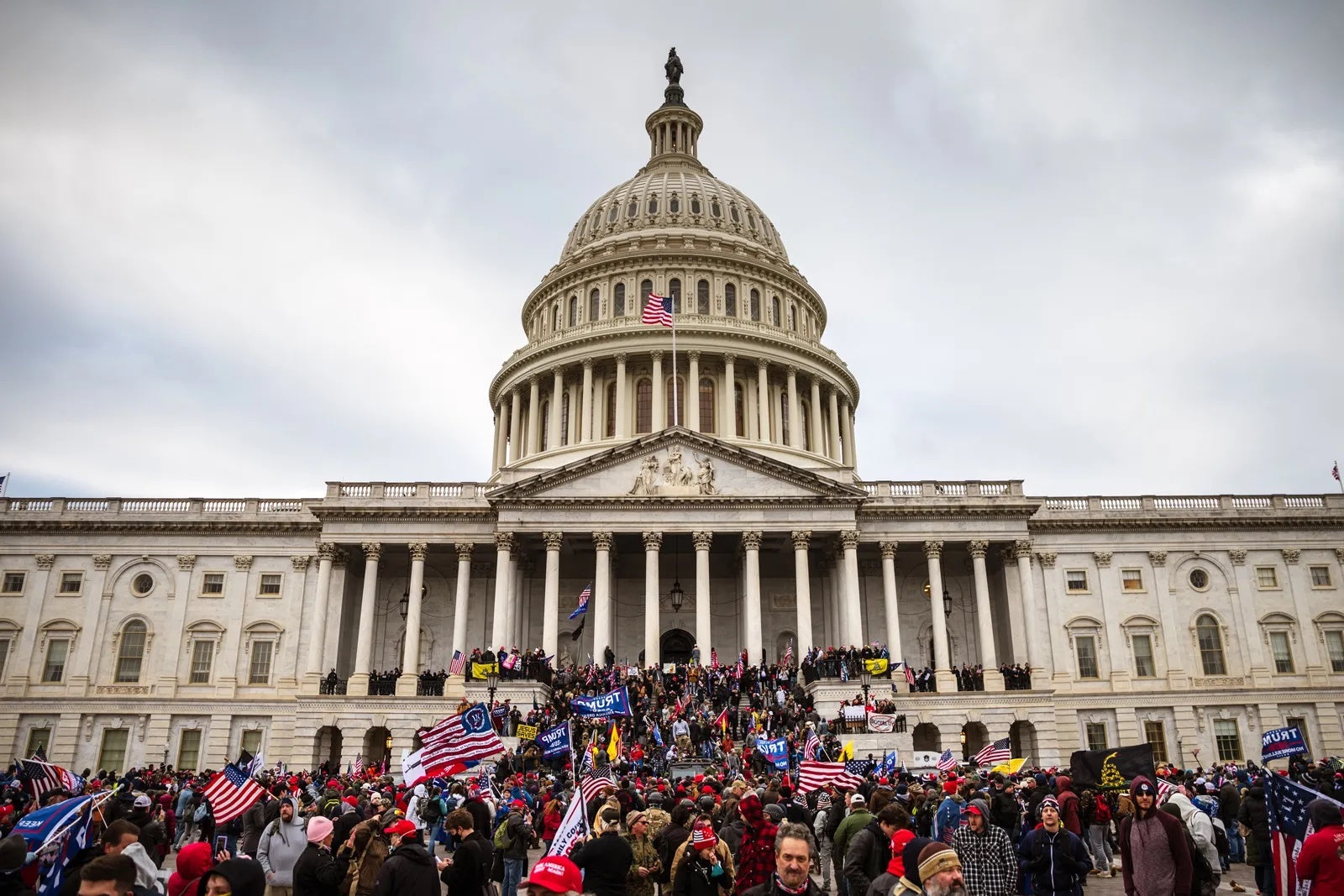
On March 14, the Department of Justice (DOJ) announced Larry Giberson ’23 was arrested in relation to the Capitol riot on Jan. 6, 2021. Giberson, a politics major from Manahawkin, New Jersey...
To: President Eisgruber, Members of the Board of Trustees of Princeton University
We are writing to you on behalf of Princetonians for Free Speech (PFS) to bring to your attention important new information relating to the petition to remove the statue of John Witherspoon from its prominent place on the plaza near Firestone Library and the Chapel. PFS is a Princeton alumni organization devoted to promoting free speech, academic freedom, and viewpoint diversity at Princeton. Thousands of Princeton alumni, as well as many students, faculty, and university staff, follow PFS on our website.
Caroline G. Hennigan and Bradford D. Kimball, Crimson Staff Writers
Harvard Crimson
Excerpt: The Harvard Law School student body voted on Thursday to call on the University to divest from Israel — delivering a decisive endorsement of language that Law School administrators harshly criticized before it went up for a vote.
The resolution, which called on Harvard to “divest from weapons, surveillance technology, and other companies aiding violations of international humanitarian law, including Israel’s genocide in Gaza and its ongoing illegal occupation of Palestine,” passed with 72.7 percent of votes in favor, with 842 students participating. Nearly 2,000 students attend HLS.
By Leslie Spencer
The Princetonians for Free Speech (PFS) third annual survey of Princeton students is now available. Comparative data over three years provides valuable information and insight into changes in student views and progress in student knowledge of and attitudes toward free speech, academic freedom and viewpoint diversity. The 2025 report shows some progress on questions such as awareness of campus free speech rules. Other results, for instance on the question of shutting down controversial campus events, are worse as compared to the last two years. The number of students who support the use of violence is up. Overall, Princeton still has much work to do to create a robust culture of free speech, academic freedom and respect for widely divergent viewpoints.