Elyse C. Goncalves and Akshaya Ravi
Harvard Crimson
Excerpt: Harvard Medical School canceled a planned Jan. 21 lecture on wartime healthcare and a subsequent panel with patients from Gaza receiving care in Boston in response to objections that students would hear from Gazans impacted by the war and not also Israelis.
Course instructors and students were notified Tuesday morning that the events — scheduled for that evening — would not be held. Medical School Dean George Q. Daley ’82 wrote in a Wednesday email sent to first-year students and obtained by The Crimson that his office began receiving complaints from students and faculty within days after the session was first publicized last week.

A UNC System Board of Governors committee on Wednesday advanced a proposal to define “academic freedom” across the state’s public universities, despite pushback from a faculty group and their lawyers. The policy, which heads to the full board for consideration next month, includes the definition that the system’s Faculty Assembly approved in October.
In part, the explanation reads that “academic freedom is the foundational principle that protects the rights of all faculty to engage in teaching, research/creative activities, service, and scholarly inquiry without undue influence.” But the system added sections that would set the “parameters” of academic freedom for faculty and its “protections” for students, such as the freedom to “take reasoned exception” to ideas presented in their classes.
Sean Stevens and Greg Lukianoff
The Eternally Radical Idea
Excerpt: We’ve both written a lot about how hostility to freedom of expression on college and university campuses has grown and intensified over the past decade. One thing that tends to go unacknowledged is that, during this time period, a tacit unholy alliance between administrators and students has emerged. In this piece, we’ll explore how this alliance has contributed to a record-breaking surge in deplatforming attempts on American college and university campuses over the past two years.
Alice Dreger
Free the Inquiry, Heterodox Academy
Excerpt: Two questions – what counts as activism in academia and what (if anything) should be done about it – formed the core of our lively webinar last Wednesday as I spoke with the University of Wyoming’s Martha McCaughey and the University of Chicago’s Tom Ginsburg and took questions from Heterodox Academy members.

A Texas A&M University dean canceled an "Ethics in Public Policy" graduate course three days into the spring semester, saying the professor refused to submit information needed to be exempt from a new ban on teaching gender and race ideology.
The dean specifically named professor Leonard Bright in a Wednesday email to his colleagues at the Texas A&M Bush School of Government and Public Service and used the course cancellation as a warning about following university processes. But Bright and other faculty advocates say they lack clarity about the rules for the ongoing course review and that administrators are using that ambiguity to their advantage.
Jacob Sullum
Reason Magazine
Excerpt: Mahmoud Khalil, a legal permanent resident who was the first target of President Donald Trump's crusade against foreign students he calls "terrorist sympathizers," could soon be released from custody thanks to a preliminary injunction that a federal judge in New Jersey granted this week. The reasoning behind that injunction underlines the chilling impact of Trump's attempt to treat speech he does not like as a deportable offense.
[U.S. District Judge Michael] Farbiarz stayed his injunction until 9:30 this morning to allow for a government appeal of his decision. That deadline came and went without an appeal. An Immigration and Customs Enforcement (ICE) official nevertheless told Khalil's lawyers "the government has no immediate plans to release him," The New York Times reports.
Schuyler Mitchell
The Intercept
Excerpt: New York University School of Law barred 31 pro-Palestine law school students from campus facilities and demanded that they sign away their right to protest in exchange for being allowed to return. If the students — deemed “personae non grata,” or PNG — don’t renounce their right to protest on campus, they will be unable to sit for final exams.

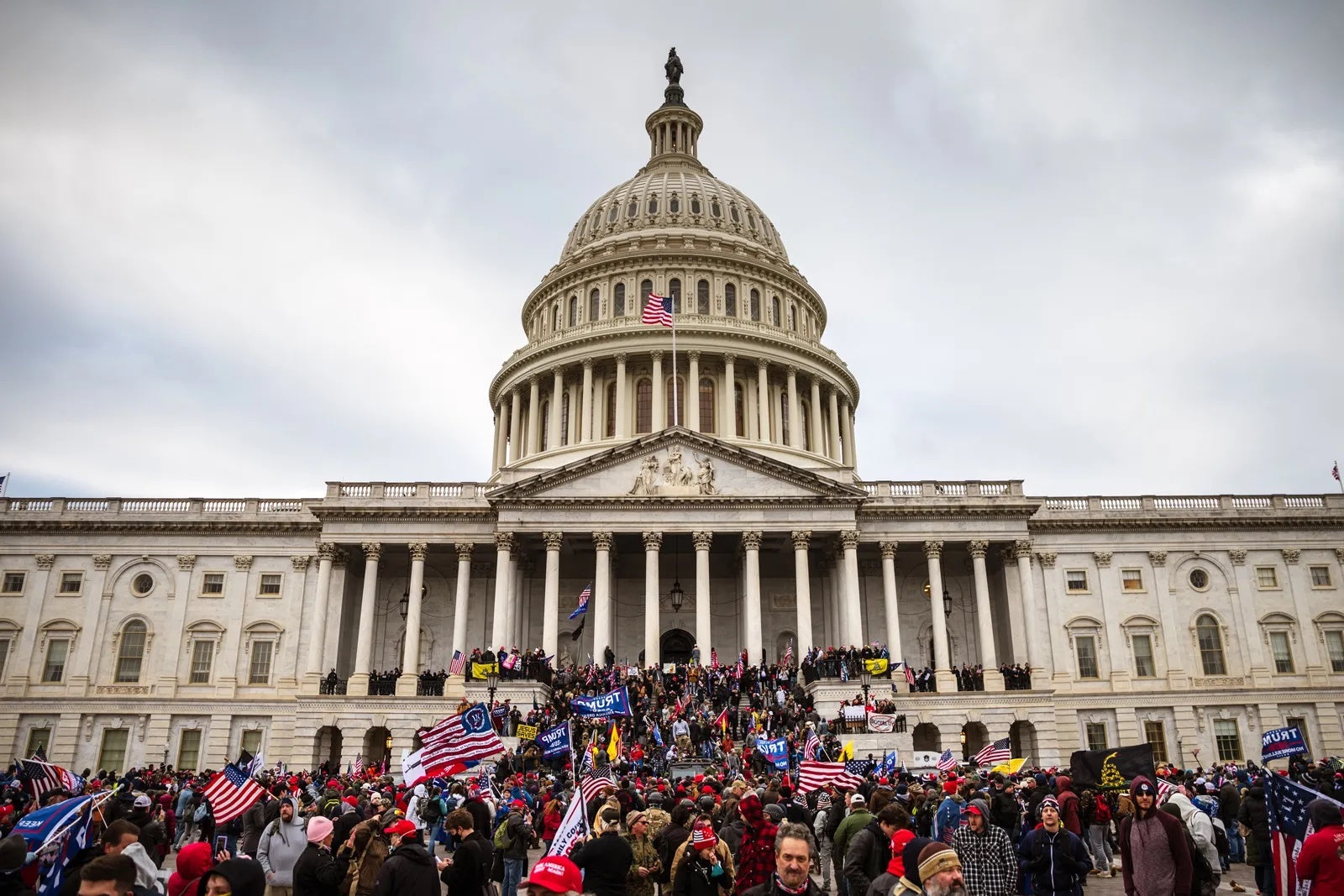
On March 14, the Department of Justice (DOJ) announced Larry Giberson ’23 was arrested in relation to the Capitol riot on Jan. 6, 2021. Giberson, a politics major from Manahawkin, New Jersey...

For the good of the Nation, university leadership must seize this occasion to drive essential reforms—a process some began by adopting positions of institutional neutrality and improving policies related to campus protests. Before the end of 2026, I call on every postsecondary institution to describe to the American public your commitments to rigorous teaching, pathbreaking research, and national service—commitments that make our universities a bedrock institution of the American republic.
Ryan Quinn
Inside Higher Ed
Excerpt: Protests of a Turning Point USA event at the University of California, Berkeley, campus Monday sparked arrests and investigation announcements from top U.S. Department of Justice officials, who alleged “Antifa” involvement. The DOJ was already investigating the UC system over various allegations, and the Trump administration has demanded UCLA pay $1.2 billion and make other concessions.
“Antifa is an existential threat to our nation,” Attorney General Pam Bondi posted on X Tuesday. “The violent riots at UC Berkeley last night are under full investigation by the FBI-led Joint Terrorism Task Force.”
Jennifer Schuessler and Vimal Patel
New York Times
Excerpt: The Foundation for Individual Rights and Expression, an increasingly prominent free-speech organization, has long been known as a fierce opponent of campus political correctness. Since its founding in 1999, it has been celebrated for defending conservatives and other dissidents from the prevailing liberal culture at America’s universities.
Greg Lukianoff with Scott Galloway
Prof G Media
Excerpt: Greg Lukianoff, a free speech advocate, first-amendment attorney, and president of FIRE, joins Scott to break down the rise of cancel culture and its chilling effect on free speech. They discuss why social media supercharged censorship, how college campuses became ground zero for speech suppression, and why younger generations may be more fragile and less free.
The Editorial Board
Wall Street Journal
Do government employees have First Amendment rights? Not according to a First Circuit Court of Appeals panel, which recently held that a public school teacher could be fired for criticizing progressive views on social media.