
by Asher Lehrer-Small, The Guardian
Since Texas lawmakers in 2021 passed a ban on lessons teaching that any one group is “inherently racist, sexist or oppressive”, a little-noticed provision of that legislation has triggered a massive fallout for civics education across the state.

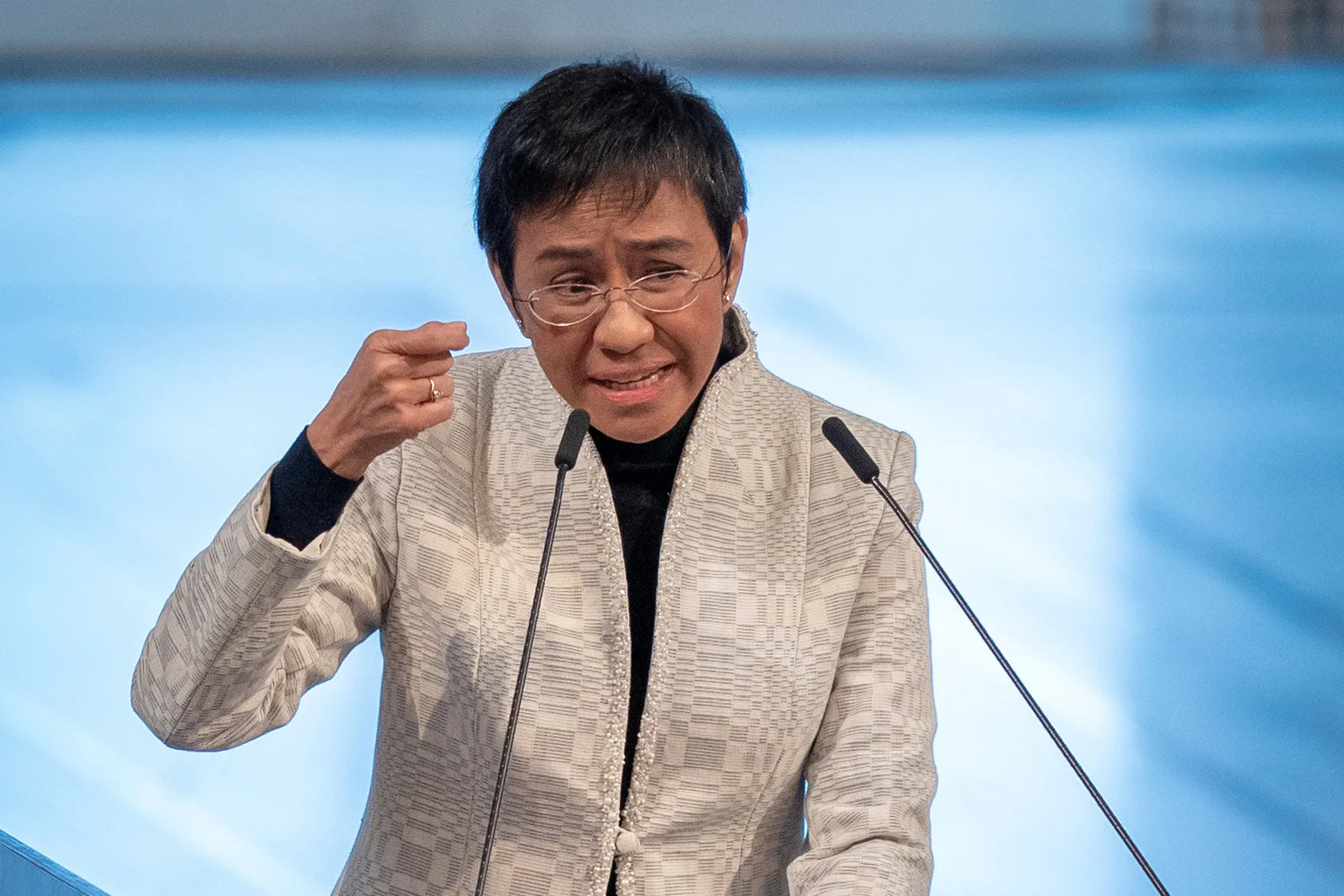
Maria Ressa, Class of 1986, received the Nobel Peace Prize in 2021 for her efforts to safeguard freedom of expression in the Philippines.

By Stuart Taylor, Jr. and Edward Yingling,
Readers of these pages are well aware that free speech, academic freedom and viewpoint diversity are in big trouble at U.S. universities. But many of those worried over the state of campuses are almost resigned to the idea that the forces of illiberal intolerance have won. The fight is far from over. On Oct. 18, five alumni groups are announcing the creation of an organization to stand up for open inquiry: the Alumni Free Speech Alliance.

To Princetonians for Free Speech Subscribers, Members and Friends,
Happy Giving Tuesday from PFS! We are grateful for the support we've received over the past 4 years from alumni like you and many others. As our Special Feature this month, we are proud to present the PFS 2024 Annual Report, which showcases our achievements over this year. We hope you will continue to help us grow our reach and impact during this season of giving!

Free speech is usually described as a right one either has or does not have, relative to the laws of one’s residence. But a right, like a muscle, is only as strong as its use. When my family flew to the United States in 2018, I naively thought that I had escaped the Chinese Communist Party’s (CCP) systematic suppression of free speech. I believed that I would access Google, YouTube, and Winnie the Pooh without any need for a VPN to circumvent the “Great Firewall of China,” a term used to describe the CCP’s firm control on online content. But I was clueless: I unknowingly carried a part of the repression within me.

Universities may be tempted to treat these capabilities as inevitable improvements in education. Students will be able to consume vast amounts of information, more than ever before. But like AI writing itself, such consumption would be vast but shallow. The more interesting possibility, then, is that AI will force universities to rediscover the value of intellectual work that cannot be outsourced.
September 18, 2023
Dear President Eisgruber and Board of Trustees:
With the beginning of a new school year at Princeton, we are writing to you on behalf of Princetonians for Free Speech (PFS) to reiterate our strong support for Princeton becoming a leader on free speech and academic freedom issues and to inform you of our efforts to assist in achieving that goal.

On April 15, 2026, Yale President Maurie McInnis announced, in an open letter to the Yale community, the issuance of a blockbuster fifty-page report by a special committee of ten Yale faculty that called for reform across many aspects of Yale’s policies and educational practices. The report dealt extensively with PFS’s core issues of free speech, academic freedom, and viewpoint diversity. But it also addressed other issues, such as affordability, admissions policies, political homogeneity, governance, grade inflation, the impact of technology on learning – all those issues that contribute to the decline in trust in higher education.

A trial began Friday for five current and former Stanford University students who occupied the university president’s offices during a pro-Palestinian protest in 2024 — in a rare instance of demonstrators facing trial for actions from the wave of campus protests that year.
Prosecutors accused the demonstrators of spray-painting on the building, breaking windows and furniture, disabling security cameras and splattering a red liquid described as fake blood on items throughout the offices. The university is seeking $329,000 in restitution.
Tom Perkins
The Guardian
Excerpt: The University of Michigan is using private, undercover investigators to surveil pro-Palestinian campus groups, including trailing them on and off campus, furtively recording them and eavesdropping on their conversations, the Guardian has learned.
The surveillance appears to largely be an intimidation tactic, five students who have been followed, recorded or eavesdropped on said. The undercover investigators have cursed at students, threatened them and in one case drove a car at a student who had to jump out of the way, according to student accounts and video footage shared with the Guardian.
Jerry A. Coyne
Why Evolution is true
Excerpt: This article in The Atlantic by Frank Foer, former editor of The New Republic (and who attended Columbia) gives a thorough and excellent summary of the history of antisemitic protests at the school. You can probably access it for free by clicking on the headline below, or you can find the article archived here. It’s well worth reading.

by Johanna Alonso, Inside Higher Ed
Students at the State University of New York at Albany don’t view their recent protest of Ian Haworth, a conservative writer and podcaster who has made provocative statements about transgender people, as a disruption of his speaking engagement on campus.

The growing (though not unanimous) acknowledgement that academia has lost public trust may be increasingly uncontroversial. But identifying remedies to repair that broken trust is proving to be much more contested.

A week before colleges must report years of admissions data to the federal government, a group of Democratic state attorneys general sued the Trump administration to block what they say is an unlawful demand.
In recent weeks, colleges and the institutional research offices tasked to collect and report the data have been sounding the alarm about the looming deadline. An association recently requested a three-month extension. The Education Department responded with a conditional three-week extension.

Iowa is considering a slate of bills that would limit speech in college classrooms and threaten academic freedom. These measures would mandate reviews of classroom content for DEI or critical race theory, remove topics like “multiculturalism” from teacher training programs, and enshrine a viewpoint-discriminatory definition of “antisemitism” into university policy.
These proposals test longstanding constitutional limits on government interference with academic freedom and classroom discussion, so let’s take a look at each one in turn.
Nicole Goodkind
CNN
Excerpt: Harvard University, like many campuses across America, continues to struggle in its contention with hate speech, protests and unrest over the Israel-Hamas war. One of its most prominent donors said Harvard needs to take urgent action to fix the problem, or it could risk a massive donor exodus.
Billionaire hedge fund CEO Bill Ackman called on Harvard to take steps to tackle a rise in “blatant antisemitism” and “anti-Israel attacks” on campus. Ackman, who received his undergraduate degree and MBA from Harvard, added that the failure to take action would put “important sources of Harvard’s revenues” at risk.

The Trump administration wants to streamline its existing higher education accountability measures with a new earnings test, holding all postsecondary programs to the same standard—regardless of the certification level or institution type involved. But doing so could water down an existing accountability measure for certificates and for-profit programs.
Under a new policy proposal, released by the Department of Education late last week, undergraduate programs would be required to show that on average their graduates earn more than a working adult with a high school degree. Programs that fail to meet those standards for multiple years could lose access to all federal loans.

A group of students and professors at public universities across Alabama are asking an appeals court to halt a state law that bans diversity, equity and inclusion initiatives in public schools and prohibits the endorsement of what Republican lawmakers dubbed “divisive concepts” related to race and gender.
The Alabama measure, which took effect in October 2024, is part of a wave of proposals from Republican lawmakers across the country taking aim at DEI programs on college campuses.
Josh Moody
Inside Higher Ed
Excerpt: Six months into his second term, President Donald Trump has forced changes at many of the nation’s wealthiest universities, some of which have shed hundreds of jobs amid federal funding issues and investigations.
While sector layoffs are so frequent that Inside Higher Ed has dedicated monthly coverage to rounding up such reductions, those actions are more common at small, cash-strapped colleges or state institutions reeling from budget cuts. But universities with multibillion-dollar endowments have been among those making the deepest cuts in the first half of 2025, often driven by freezes on federal funding that the Trump administration imposed with minimal notice.
Johanna Alonso
Inside Higher Ed
Excerpt: More than three months after a federal court struck down an Education Department directive that barred any practices that consider race at colleges across the country, the Department of Justice declared Wednesday that diversity, equity and inclusion practices are unlawful and “discriminatory.”
But the agency’s memo goes even further than ED’s guidance, suggesting that programs that rely on what they describe as stand-ins for race, like recruitment efforts that focus on majority-minority geographic areas, could violate federal civil rights laws. The directive applies to any organization that receives federal funds, and DOJ officials warned that engaging in potentially unlawful practices could lead to a loss in grant funding.
Chris Cooper
Inside Higher Ed
Excerpt: It is worth noting that most DEI initiatives and offices on campus offer noncontroversial services like tutoring, mental health counseling and accessibility services like sign language interpreters. But the public and politicians were forming their opinions of DEI based on the voices of those with the megaphones and lucrative book contracts.
Current legislation targeting DEI upholds the most radical media-amplified voices as representative of the whole, even though these voices have been largely unsuccessful on many public campuses. Our university is not Columbia or Harvard, yet it seems as if legislators are attempting to punish our institution for the sins of its private counterparts. But when there are no loud moderate voices, how can we expect the public to see anything other than the extremes?
Jennifer Ruth
Academe Blog
Excerpt: Yesterday, the Department of Education announced investigations into Columbia University, Northwestern University, Portland State University, the University of California, Berkeley, and the University of Minnesota–Twin Cities, explaining that “widespread antisemitic harassment has been reported” at these five institutions.
Given the confusion that reigns in and over higher education today, it’s worth trying to think this through a bit.

The first step to recovery is admitting you have a problem. For years, the core argument of Princetonians for Free Speech was treated by university administrators as a provocation rather than a diagnosis. The claim that American higher education had drifted from its foundational mission, that a culture of ideological conformity and administrative overreach had corroded the open inquiry that justifies the university’s privileged place in democratic life, was dismissed as politically motivated, answered with defensive boilerplate, or simply ignored. That era appears to be ending. No dramatic reversals have taken shape yet, but something significant is happening. The academy itself—the ivory tower that prides itself on being above and beyond the slings and arrows of the outside world—is beginning to acknowledge that the critics had, and have, a point.
Dear President Eisgruber:
We, the undersigned students, write on behalf of the Princeton Open Campus Coalition (POCC), a group of undergraduates committed to the philosophy that a university cannot fulfill its mission without...