
On with Kara Swisher
Excerpt: Universities and free speech are at the center of America’s culture wars. And since President Trump took office, higher education has been in the crosshairs — and Princeton University president Christopher Eisgruber is one of the few college leaders speaking out.
In this episode, Kara talks with Eisgruber about his new book, Terms of Respect: How Colleges Get Free Speech Right, and the growing attacks on universities, free speech, and academic freedom.
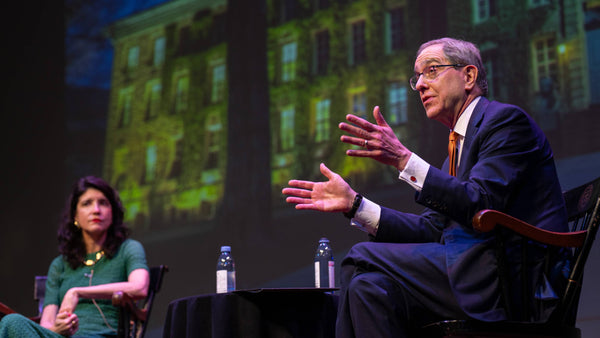
Last year at an event hosted by the DC Center of Princeton’s School of Public and International Affairs (SPIA), the host of NPR’s “Weekend Edition Sunday” Ayesha Rascoe asked President Eisgruber if today’s students are “fragile flowers who can’t deal with anything challenging their preconceived notions?” In response, Eisgruber shared that he in fact has observed quite the opposite.
The truth about free speech on college campuses and in civic discourse in American society is more complex than individuals’ inability to handle opposing viewpoints. In reality, it is external complications that influence whether an individual decides to speak openly about a belief or position they hold. Students and leaders are consistently weighing whether openly expressing their opinion is worth the political, social, or financial repercussions that could arise as a result.
On Feb. 28, U.S. and Israeli forces launched joint attacks on Iran, starting a war that has now lasted nearly four weeks.
Despite the 6,000-mile distance between New Jersey and Iran, many University community members have expressed concerns about the destruction happening in the Middle East, as well as confusion about American motivations for entering the war.
The Anti-Defamation League has given Princeton a C in its third annual Campus Antisemitism Report Card earlier this month. In 2024, Princeton got an F on its first report card.
The ADL has historically been considered one of the most prominent Jewish civil rights organizations, though its credibility has been contested in recent years. The league assesses 150 colleges and universities nationally, but many members of the Jewish community on campus consider the C grade to be unreflective of the state of Jewish life at Princeton, believing that Princeton deserves a higher grade.