
Caroline G. Hennigan and Bradford D. Kimball, Crimson Staff Writers
Harvard Crimson
Excerpt: The Harvard Law School student body voted on Thursday to call on the University to divest from Israel — delivering a decisive endorsement of language that Law School administrators harshly criticized before it went up for a vote.
The resolution, which called on Harvard to “divest from weapons, surveillance technology, and other companies aiding violations of international humanitarian law, including Israel’s genocide in Gaza and its ongoing illegal occupation of Palestine,” passed with 72.7 percent of votes in favor, with 842 students participating. Nearly 2,000 students attend HLS.
The shooting at Brown is deeply tragic. But it is not the time for mere thoughts and prayers. It hasn’t been for decades. As another Ivy League university, this moment calls for Princeton to stand in solidarity with the victims of the Brown shooting by pushing for significant reform to fight violence. University President Christopher Eisgruber ’83 is uniquely equipped as the past chair and active board member of the Association of American Universities (AAU) — an organization with a precedent of condemning gun violence — to lobby for gun reform policies on the national and state level.
A discussion about Fizz and the role of social media in our discourse took place at Princeton University on December 3rd, 2025, hosted by the Princeton Open Campus Coalition (POCC) and funded by Princetonians for Free Speech (PFS), While the discussion has been lauded as an example of what can come about through open and civil exchange of ideas, several questions remain worth considering. What is the place of anonymous speech in our society? Should someone take responsibility for the things they say? Or has our public discourse been hollowed out by social media to the point where online commentary should be considered performative?
Tal Fortgang ‘17
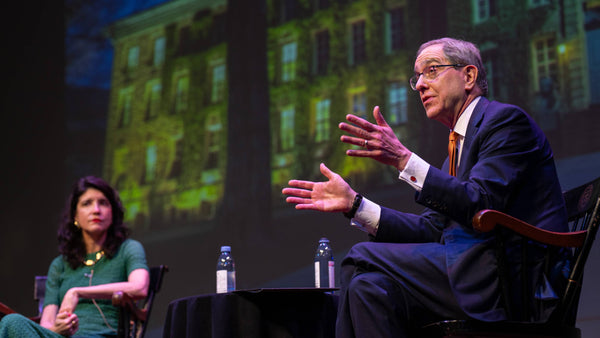
When Princeton President Christopher Eisgruber spoke at Harvard on November 5, 2025, he expressed what to his detractors may have sounded like an epiphany. “There’s a genuine civic crisis in America,” he said, noting how polarization and social-media amplification have made civil discourse uniquely difficult. Amid that crisis, he concluded, colleges must retain “clear time, place, and manner rules” for protest, and when protesters violate those rules, the university must refuse to negotiate. As he warned: “If you cede ground to those who break the rules … you encourage more rule-breaking, and you betray the students and scholars who depend on this university to function.”