

Amelia Freund
Princetonians for Free Speech
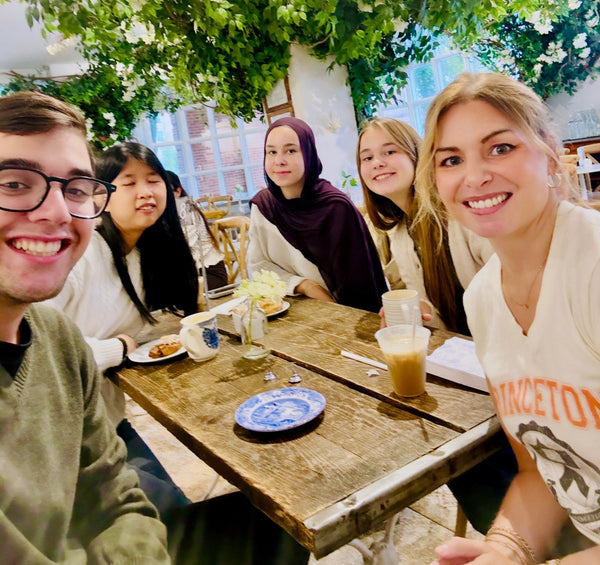
My name is Amelia Freund and I am honored to be serving as President of the Princeton Open Campus Coalition (POCC) this year. An Army brat hailing from the DC-Maryland-Virginia area, I am a member of the great class of 2028, the Butler College Class Council, and the Politics Department. In high school I read On Liberty by John Stuart Mill several times over in my philosophy courses, each time I found it engaging and inspirational. I was particularly drawn in by Mill’s defense of free speech. He believed that for an idea to be true, it must be continuously discussed and debated, requiring broad protections for civic discourse. His argument resonated with me a great deal, and has carried me to countless engagements with freedom of speech since then, both in and out of the classroom.
Last fall I was a wide-eyed freshman looking for anything related to free speech I could find on campus, so I was delighted to stumble into a POCC’s Biden v. SCOTUS debate about whether or not the Supreme Court should be restructured. After immensely enjoying the event, I soon found myself on the Executive Committee and starting POCC’s Instagram account (@princetonocc). This past summer I officially took the reins as president.
For those of you new to POCC, we were founded in the fall of 2015 by an ideologically diverse group to promote and protect a culture of open civil discourse on campus after noticing anti-free speech sentiments increasing among students on campus. Guided by principles of academic freedom and truth seeking, POCC has been led by many different students, holding a wide variety of opinions on political and other matters, but has always maintained its commitment to engaging in conversation guided by tools of logical reasoning and assuming the best in each other. Over the years POCC has spoken out against speech-chilling policies or incidents such as the occupation of President Eisgruber’s office, released open letters to the administration on cultural competency training for faculty, and facilitated the inclusion of a free expression event during first-year orientation. As POCC nears our ten year anniversary, we continue to be reminded of why our mission matters in 2025.
Earlier this month, POCC hosted Robert Corn-Revere, Chief Counsel of the Foundation for Individual Rights and Expression (FIRE) at our first event of the year, From Anthony Comstock to South Park: America and The Culture of Free Expression. An accomplished First Amendment lawyer, Corn-Revere lectured on the topic of his most recent book: The Mind of the Censor and the Eye of the Beholder. Beginning with tactics of the infamous Anthony Comstock, Corn-Revere detailed the cycles of cultural censorship history in the United States leading us all the way up to the present with the recent South Park controversy. He presented a compelling argument that similar stories of suppression repeat themselves about every ten years, although the subjects change with the times. We cannot thank him enough for leading such an engaging and relevant discussion with our students.
We know that free speech is not easy or comfortable. As Ambrose Redmoon put it, “courage is not the absence of fear but rather the judgement that something else is more important.” In this day and age, it increasingly requires an enormous amount of courage in both the speaker and the listener. POCC believes that academic freedom and truth-seeking are worth the price. To further our work, this year we are moving towards a more regular presence on campus by hosting events all year. Announcements for our next fall event should be out soon. We cannot wait to see you there!
Editor’s note: Princetonians for Free Speech defends free speech for all. We aim to support all student organizations that protect free thought and expression, and promote a better culture for wide open discourse and free inquiry at Princeton. Aligned student groups are encouraged to contact PFS (updates@princetonfs.org) to discuss ways to connect and partner.

Leave a comment
Comments will be approved before showing up.