Your Cart is Empty

Stuart Taylor Jr., president of "Princetonians for Free Speech" and an RCP contributor, joined Tom Bevan, Friday on the RealClearPolitics podcast, to talk about the Trump administration’s decision to suspend hundreds of millions of dollars in grants to Princeton.
They discuss this piece by Christopher Rufo and Ryan Thorpe in City Journal: "Princeton’s War on Civil Rights"
Stuart Taylor Jr., president of "Princetonians for Free Speech" and an RCP contributor, joined Tom Bevan, Friday on the RealClearPolitics podcast, to talk about the Trump administration’s decision to suspend hundreds of millions of dollars in grants to Princeton.
They discuss this piece by Christopher Rufo and Ryan Thorpe in City Journal: "Princeton’s War on Civil Rights"
Jocelyn Gecker
Associated Press
Americans are increasingly skeptical about the value and cost of college, with most saying they feel the U.S. higher education system is headed in the “wrong direction,” according to a new poll.
Overall, only 36% of adults say they have a “great deal” or “quite a lot” of confidence in higher education, according to the report released Monday by Gallup and the Lumina Foundation. That confidence level has declined steadily from 57% in 20
Katherine Knott
Inside Higher Ed
A federal district judge on Tuesday blocked the Biden administration from enforcing its new regulations for Title IX of the Education Amendments of 1972 in Alaska, Kansas, Utah and Wyoming.
Judge John Broomes of the District of Kansas wrote in a 47-page opinion that the Education Department lacked the authority to expand prohibited sex-based discrimination under Title IX to include discrimination based on gender identity and that the new regulations could chill speech “through vague and overbroad language.” The protections for LGBTQ+ students are at the heart of the Kansas lawsuit and other legal challenges.
Matthew Wilson, Daily Princetonian
Excerpt: As I write this essay, the despicable poison of Jew-hatred has taken a firm hold at so many college campuses, Princeton included. Here at Princeton, activists proudly chant “Intifada” and demand the complete eradication of the world’s only Jewish state; elsewhere, from Cornell, Harvard, and the University of Pennsylvania to Ohio State and Cooper Union, frightening (and sometimes violent and illegal) exhibitions of anti-Jewish attitudes abound.
For the most part, university responses to these shameful displays have been tepid and restrained. these same universities, despite being so reticent to speak out now, have a prolonged public history of weighing in on a wide array of hotly contested and politically controversial topics. At Princeton, for instance, recent years have seen official statements issued deploring Supreme Court rulings on abortion and affirmative action, condemning a jury verdict, and attacking a professor for his political views. On Hamas’s terrorist attacks? No official statements.
The Editorial Board
Wall Street Journal
Do government employees have First Amendment rights? Not according to a First Circuit Court of Appeals panel, which recently held that a public school teacher could be fired for criticizing progressive views on social media.
Jay Bhattacharya & Wesley J. Smith
RealClearPolitics
The New England Journal of Medicine recently published an advocacy article that attacks academic freedom and urges stifling contentious campus debates. Specifically, Evan Mullen, Eric J. Topol, and Abraham Verghese urge universities to “speak out publicly” and issue official institutional opinions about public controversies involving its professors “when it concludes that a faculty member’s opinion could cause public harm.”
Greg Lukianoff
The Eternally Radical Idea
While I certainly know critics of Israel who are not at all motivated by anti-Semitism, I have run into a lot more outright anti-Semitism over the past 10 years — and particularly in the last six months — than I ever thought I'd see in my lifetime. Anti-Semitism is vile, and I believe it is absolutely a growing problem today.
Given my point of view on this, it might be surprising to people that FIRE and I oppose the Antisemitism Awareness Act. To those who understand how a viewpoint-neutral defense of the First Amendment works in practice, however, this should come as no surprise at all.
Lauren A. Wright
The Atlantic
Right-wing commentators relish painting elite college students as ignorant, weak, and unprepared to meet the real world. Students have bolstered this perception by struggling to articulate positions on issues for which they profess deep concern.
But this grim picture leaves out an important distinction: Conservative students, rather than being coddled, face significant intellectual and social challenges in college. These challenges impart educational advantages by forcing conservatives to defend their points of view. Liberal students, surrounded by like-minded peers and mentors, have less opportunity to grow in this way.
Jessie Appleby
FIRE
Were the Gaza solidarity encampments erected on college campuses this spring an effective, or even legitimate, form of protest? Is Israel committing genocide in Gaza? It depends on who you ask. But how, if at all, should faculty handle these questions in class?
The manner in which faculty tackle contested or controversial issues in college classrooms is a source of perennial debate. That debate over preferred pedagogy reignited last month when a nonprofit organization accused a public college in California of violating students’ First Amendment rights based on incidents in which two professors seemingly injected their personal views on hot-button political issues into assigned classwork.
Katherine Rosman
New York Times
Three Columbia University administrators have been removed from their posts after sending text messages that “disturbingly touched on ancient antisemitic tropes” during a forum about Jewish issues in May, according to a letter sent by Columbia officials to the university community on Monday.
The administrators are still employed by the university but have been placed on indefinite leave and will not return to their previous jobs.
Tim Carpenter
Kansas Reflector
Gov. Laura Kelly and top legislative leaders voted Tuesday to allocate $35.7 million to public higher education after the Kansas Board of Regents certified campus administrators complied with a state law forbidding employment and admissions decisions to be based on diversity, equity and inclusion policies.
The 2024 Legislature made distribution of the university operating grants contingent on affirming DEI no longer dictated faculty or staff hiring nor influenced whether a student was admitted.
Gavin Farinholt
The College Fix
The Massachusetts Institute of Technology made headlines in May when its leaders told faculty to discontinue the practice of requiring mandatory diversity, equity and inclusion statements in faculty hiring.
But a prominent MIT alumni group argues the move is not enough to protect free speech, academic freedom and intellectual diversity, and is calling on campus leaders to go further.
Chris Linder
Inside Higher Ed
I was a victim advocate on a college campus for seven years. Since 2011, I have worked as a faculty member whose research, teaching and activism focuses on addressing sexual violence among college students. And for the past five years, I’ve led the development of a center for violence prevention on a campus where three women were murdered by domestic or dating partners in one year, followed by an additional alleged domestic violence homicide four years later.
Few things make me more ashamed or angry than the way the federal government attempts to intervene in sexual misconduct on college campuses. Politicians use survivors and transgender students as pawns in a political power struggle.
By Edward Yingling and Stuart Taylor, Jr.
Daily Princetonian
Excerpt: In its May 2 article entitled “A decade later: a split legacy for Eisgruber,” the Daily Princetonian erred in saying that “Edward Yingling ’70 and Stuart Taylor ’70, co-founders of Princetonians for Free Speech” (PFS) argued that Eisgruber’s decision to fire then-professor Joshua Katz would “destroy Princeton’s acclaimed free speech rule” — making the free speech rule one that would protect only a small subset of the speech that the rule’s language and intent clearly do protect.
Open Video of James Madison Program Panel Discussion on “The Fight for Free Speech at Princeton and Beyond” During 2022 Princeton Reunions configuration options
by Stuart Taylor Jr. & Edward Yingling
National Review
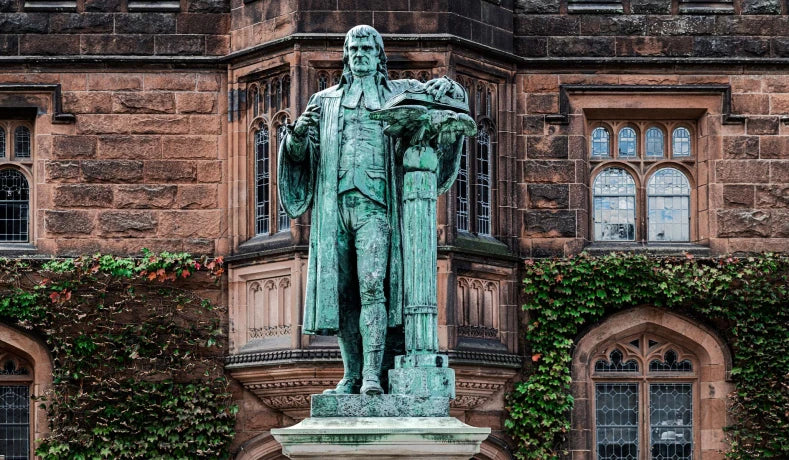
Excerpt: Princeton University is tiptoeing toward canceling its greatest president and a founder of our nation in a process that its trustees and president Christopher Eisgruber accelerated on October 2 by announcing that they would leave the statue of John Witherspoon in its prominent place on Firestone Plaza — but probably only for now. The issue has been punted to the “Campus Art Steering Committee” to decide whether the statue should be moved, or removed.

by Stuart Taylor, Jr., for National Review
After the woke take down Witherspoon, if they succeed, who might be next? Maybe President (of the United States) James Madison, Founding genius and drafter of the First Amendment?
by Edward Yingling and Stuart Taylor
RealClear Politics
Excerpt: The lists of “top colleges” have varied little in many years. They always include the Ivies, Stanford, MIT, Cal Tech, etc. But that could change. Colleges of all types can differentiate themselves on the core values of free speech and academic freedom, and those that do will increasingly attract more and better students, faculty, and employment opportunities for their graduates.
Edward Yingling and Stuart Taylor
RealClear Politics
Jun 20, 2023
Excerpt: The lists of “top colleges” have varied little in many years. They always include the Ivies, Stanford, MIT, Cal Tech, etc. But that could change. Colleges of all types can differentiate themselves on the core values of free speech and academic freedom, and those that do will increasingly attract more and better students, faculty, and employment opportunities for their graduates.
In many ways, Marisa Hirschfield ’27 represents the typical high-achieving Princeton student. A history major, Hirschfield writes for the Triangle Club and is interested in filmmaking and public interest law. Like many Princetonians, she identifies as politically progressive.
But where Hirschfield’s resume diverges from many of her classmates is that she serves as a writing fellow for Princetonians for Free Speech (PFS), a nonprofit founded by Stuart Taylor Jr. ’70 and Ed Yingling ’70 that seeks to promote free speech and academic freedom on campus. At Princeton, the free speech issue has been contested for the past several years but mostly involved conservative students who felt that they were being silenced or bullied for their views.
by Edward Yingling
Real Clear Politics
Results of a new survey of Princeton students sponsored by PFS has just been released. Today Real Clear Politics published an article by PFS co-founder Ed Yingling that highlights the survey’s key findings
Edward Yingling & Stuart Taylor, Jr.
RealClearPolitics
Excerpt: Free speech is very much in today’s headlines, especially with the outraged demands for technology companies to banish -- or not -- from their platforms speech they consider incitements to violence or hateful. But the greater danger may be the hostility within our colleges and universities to the free speech and academic freedom of faculty and students, and even alumni, who dissent from the views dominant on campuses today. Surveys show that a high, and growing, number of college students are opposed to free speech and to what the Supreme Court has called the “profound national commitment to the principle that debate on public issues should be uninhibited, robust, and wide-open.” As Princeton alumni and lawyers who have a strong belief in the vital importance of free speech, we have recently co-founded Princetonians for Free Speech. We have started by appealing mainly to alumni because they are the only university stakeholders who have the numbers and the capability to defend these basic freedoms effectively in campus environments where students and faculty who openly support free speech are outnumbered and outgunned by those who oppose it. But we hope to find allies among faculty and students as well.

Dear President Eisgruber,
You and I have never met. Nor are we likely to meet because it has been very rare that I attend my class reunions. However, I have followed your career as President of Princeton, because I read the Princeton Alumni Weekly (which is, of course, no longer published weekly)...
Edward Yingling and Stuart Taylor, Jr.
RealClearPolitics
Excerpt: Like alumni of universities across the country, many Princeton graduates have become deeply concerned about the attacks on free speech and academic freedom at our alma mater. It is not just the public attacks that are of concern. Multiple national and college-specific polls have shown that faculty and students are afraid to say what they think. Princeton is no different. One student told us he was afraid to speak up not just because he would be attacked, but because others with whom he was working on a project might also be attacked for associating with him.
By Stuart Taylor, Jr. and Edward Yingling, The Wall Street Journal
Readers of these pages are well aware that free speech, academic freedom and viewpoint diversity are in big trouble at U.S. universities.
By Edward Yingling and Stuart Taylor Jr
In July 2020, a Princeton University professor, Joshua Katz, wrote an article containing provocative language that generated controversy on campus. While voicing strong disagreement with that language, Princeton President Christopher Eisgruber clearly and publicly stated a few days later that it was protected by Princeton’s university-wide rule on free speech. But since then, through other Princeton officials, the university has for over a year viciously attacked Professor Katz as a racist on its website and elsewhere for the exact same language. These attacks have clearly violated the Princeton free speech rule, as well as other Princeton rules.
By Stuart Taylor, Jr. and Edward Yingling,
Readers of these pages are well aware that free speech, academic freedom and viewpoint diversity are in big trouble at U.S. universities. But many of those worried over the state of campuses are almost resigned to the idea that the forces of illiberal intolerance have won. The fight is far from over. On Oct. 18, five alumni groups are announcing the creation of an organization to stand up for open inquiry: the Alumni Free Speech Alliance.
By Edward Yingling and Stuart Taylor Jr
Originally published in Real Clear Politics
In July 2020, a Princeton University professor, Joshua Katz, wrote an article containing provocative language that generated controversy on campus.
By Edward Yingling, Stuart Taylor Jr., and Todd Rulon-Miller
We are writing on behalf of Princetonians for Free Speech (PFS) on a matter of utmost urgency. Princeton has now reached the point where free speech is no longer protected and where those who do try to exercise free speech can be viciously attacked with no consequences, and even attacked by the University itself.
This article by PFS co-founder Stuart Taylor, Jr. recounts the controversy surrounding the Witherspoon statue located on Firestone Plaza. The attempted cancellation of Witherspoon and what it means for academic freedom at Princeton has been a focus of our attention, as you can see in our just-published Annual Report HERE. If you like what we are doing, please consider a year-end donation to PFS HERE.
The University’s official proceedings on the petition by assorted students and faculty members to remove from its prominent setting on Firestone Plaza the bronze statue of Princeton’s greatest president, John Witherspoon, are looking bleak for the statue, for the memory of Witherspoon, and perhaps also that of other founders of the United States.
The second and apparently final symposium on the statue, held on November 3 by the University’s Committee on Naming, was notable for the absence of any unambiguous statement by any of the five invited speakers or by the moderator, Associate Professor Beth Lew-Williams, that the statue should be left standing undisturbed where it was placed in 2001, with the strong support of respected then-President Harold Shapiro.
April 9, 2025
Dear President Eisgruber:
We, the officers of Princetonians for Free Speech (PFS), are writing to express our organization’s very deep concerns about the disruption of the program featuring former Israel Prime Minister Naftali Bennett on April 7 and actions of severe antisemitism during and after that program.

To PFS subscribers, members and friends,
April saw a major campus protest, one that disrupted and cut short an April 7 event featuring former Israeli Prime-Minister Nefthali Bennett. This disruption was by far the worst we have seen on Princeton’s campus. In response,PFS issued two letters to President Eisgruber and the administration. The first letter was sent on April 9 in the immediate aftermath of the event. It makes specific recommendations for swift action to sanction those responsible for breaking university rules. Anticipating a possible recurrence at an April 22 event with Yechiel Leiter, the new Israeli Ambassador to the US, PFS sent the second letter on April 18, outlining measures not taken at the first event, that are critical to preventing more disruption.