
Talk with Israeli ambassador met with protests and increased PSafe presence, but no disruptions inside

Kian Petlin  April 22, 2025 1 min read

Kian Petlin 
Daily Princetonian 

Excerpt: Two weeks ago, former Israeli Prime Minister Naftali Bennett visited campus to protests and a full lecture hall. His talk was interrupted several times, including by a walkout and a fire alarm — a remarkable spate of disruptions that prompted a University investigation, a public apology from University President Christopher Eisgruber ’83, and even a stand-alone editorial in The Wall Street Journal.

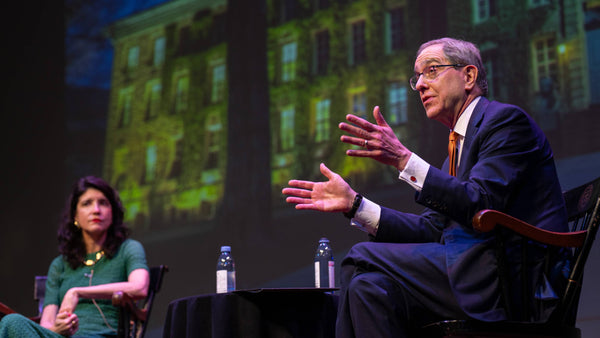
On Tuesday, another prominent figure in Israeli politics — this time the Israeli ambassador to the United States — came to give a talk. This time, he was met by a scaled-down audience, a smaller protest, and no disruptions inside — as well as a small army of Public Safety (PSafe) officers, University security, and free speech coordinators to ensure nothing went awry.
Click here for link to full article 


Leave a comment

Comments will be approved before showing up.


Also in Princeton Free Speech News & Commentary

Civic Education Centers Are Booming. The AAUP Wants Them Gone.

By Tal Fortgang ‘17 July 14, 2026 6 min read

Faith in higher education continues to plummet, and the American Association of University Professors (AAUP)—the nation’s leading organization representing faculty interests and a longstanding voice on academic freedom and university governance—has decided to train its guns on the growing movement to establish civic education centers at public universities. The AAUP’s objections amount to a single, unlovely demand: we get to decide what students learn, and nobody else gets a vote.

Read More
Is Anthropology Hopelessly Politicized?

Stephanie M. Lee July 14, 2026 1 min read

Six days after the report went online, the AAA fired back with a full-throated defense. “Anthropologists welcome rigorous critique of the discipline,” wrote its president, Carolyn M. Rouse. “What we cannot accept is a sweeping verdict about anthropology’s intellectual culture, scholarly practices, and professional norms built on selective evidence and issued without consultation. 

Read More
Princeton’s Return to Proctored Exams Reflects Changing Times

Julie Bonette July 07, 2026 1 min read

Since faculty voted in may to proctor in-person exams, national news outlets and some alumni have decried the end of Princeton’s 133-year-old tradition of unsupervised testing, but students, faculty, and recent graduates say the conversation within the campus community has been mild.

Read More