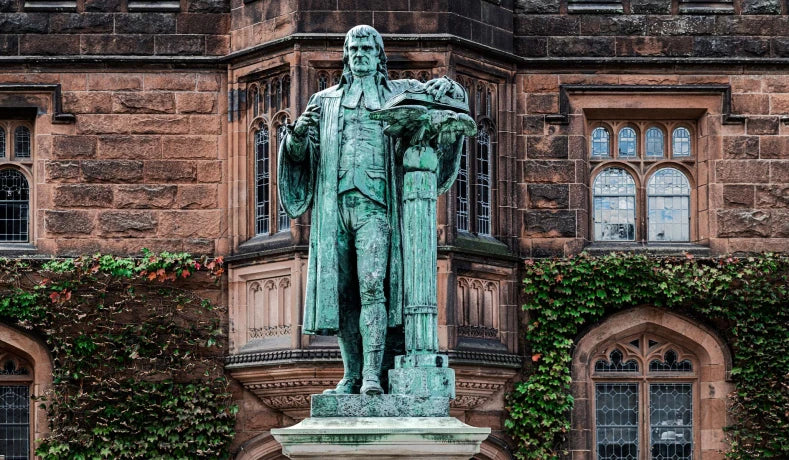
Princeton University Should Not ‘Cancel’ John Witherspoon

January 14, 2023 1 min read

1 Comment

Princeton University Should Not ‘Cancel’ John Witherspoon

by Stuart Taylor, Jr., Co-founder, Princetonians for Free Speech
Published in National Review

After the woke take down Witherspoon, if they succeed, who might be next? Maybe President (of the United States) James Madison, Founding genius and drafter of the First Amendment? A Princeton graduate (1771), Madison stayed on an extra year to study under Witherspoon and lends his name to the university’s James Madison Award for Distinguished Public Service. He had far more than two slaves. Would Princeton spare the two iconic paintings of George Washington — with his hand on a cannon and with the College of New Jersey, as Princeton was then known, in the background during the Battle of Princeton, and at ease after winning it — by Charles Willson Peale, who himself experienced the battle firsthand?


Read more >>>


1 Response

James R. Wells, '46
James R. Wells, '46

April 05, 2024

Such nonsense!!! Don’t the spoiled children attending Princeton these days, know they have a rare privilege to grow up in a classical surrounding? They are there to learn – not dispense their childish beliefs.

They might well adapt the concept of maintaining an open mind, and inquiring as to what they might discover as they struggle to mature, rather than egotistically supposing they are already blessed with sufficient knowledge to make judgements regarding how Princeton should be governed and what portions of the past are worthy (in their self-deluded mind) to be retained. Take time to grow up, little ones; you’re there to acquire wisdom – not dispense it.

JRW

Leave a comment


Also in Princeton Free Speech News & Commentary

Why Princeton needs opinion journalism

January 20, 2026 1 min read

In an age of social media, access to news and information can seem less like a privilege than a tidal wave. What we end up seeing isn’t fully objective: It’s composed, in large part, of opinions and biased perspectives that arise in the aftermath of striking or unsettling events. As long as you have a device and an internet connection, you can share and consume opinions on any given subject with minimal vetting.

There’s no shortage of editorialized content in the world today. So why would you specifically seek out the opinion page of a newspaper, and why ours in particular? What do we, as a student newspaper, have to offer you as a member of the Princeton community?

Read More
Does President Eisgruber Get Free Speech Right? Part I: What Eisgruber Gets Right

January 15, 2026 7 min read 4 Comments

“When it comes to getting free speech right,” writes Princeton University President Christopher Eisgruber in the introduction to Terms of Respect, “America’s young people deserve higher marks than they get.” This is a central contention of Eisgruber’s new book, and it is, as those young people say, big – if true.

It also begs the question twice over, in the way that is all but inevitable when we talk about higher education and speech, two goods contemporarily treated as goods of themselves, if not the highest goods. Whether Eisgruber’s contention is correct depends on what is meant by free speech, then again on what is meant by getting it right.

Read More
Equality vs. Free Speech: A Debate at the Annual Tanner Lecture

January 07, 2026 4 min read

On November 12, former ACLU Legal Director David Cole delivered the annual Tanner Lecture on Human Values. His talk, entitled “A Defense of Free Speech from Its Progressive Critics,” drew a crowd to the Friend Center. Cole has litigated several major First Amendment cases and currently serves as a law professor at Georgetown. A self-identified progressive, Cole explicated an argument in favor of the First Amendment.

Cole outlined the main progressive critiques of the First Amendment. “What unites these critiques is the sense that the First Amendment is too protective at the cost of another very important value in our society: equality.” He also acknowledged the progressive skepticism of free speech’s “core demand” of neutrality – the idea that the government “must be neutral as to the content and viewpoint of speech when it is regulating private speakers.”

Read More