
Commentary: To stop intimidation, Eisgruber needs your help

March 23, 2025 1 min read

Guest Contributors
Daily Princetonian

Excerpt: Columbia University appears to have given in to the government’s anti-constitutional and autocratic attack on free speech and the rule of law. In the face of Project 2025-inspired demands from the Trump administration, Columbia expelled students and revoked degrees. On Friday, they announced further concessions, including, most concerningly to us, the removal of academic self-governance from the Department of Middle Eastern, South Asian, and African Studies.  

Princeton, along with 59 others, is on a list of universities targeted by the administration. President Eisgruber has started the pushback, standing up on behalf of academic freedom and saying that the Trump administration is attacking higher education. Professors, students, other universities, and the public should join him.
Click here for link to full article


Leave a comment


Also in Princeton Free Speech News & Commentary

Hollow Rules: The Ivy League’s Mixed Messaging on Campus Disruption

December 11, 2025 8 min read

Tal Fortgang ‘17

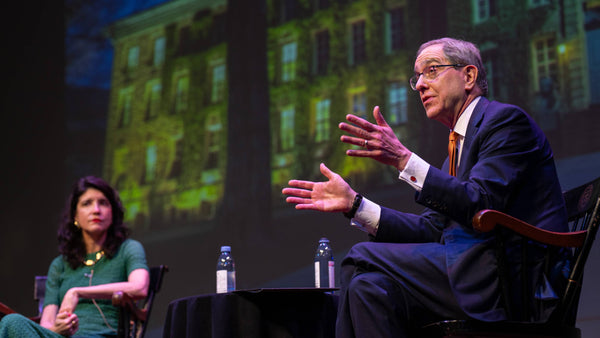
When Princeton President Christopher Eisgruber spoke at Harvard on November 5, 2025, he expressed what to his detractors may have sounded like an epiphany. “There’s a genuine civic crisis in America,” he said, noting how polarization and social-media amplification have made civil discourse uniquely difficult. Amid that crisis, he concluded, colleges must retain “clear time, place, and manner rules” for protest, and when protesters violate those rules, the university must refuse to negotiate. As he warned: “If you cede ground to those who break the rules … you encourage more rule-breaking, and you betray the students and scholars who depend on this university to function.”

Read More
Without affirmative action, elite colleges are prioritizing economic diversity in admissions

December 11, 2025 1 min read

Collin Binkley 
Associated Press 

Some of the country’s most prestigious colleges are enrolling record numbers of low-income students — a growing admissions priority in the absence of affirmative action.

At Princeton University, this year’s freshman class has more low-income students than ever. One in four are eligible for federal Pell grants, which are scholarships reserved for students with the most significant financial need. That’s a leap from two decades ago, when fewer than 1 in 10 were eligible. “The only way to increase socioeconomic diversity is to be intentional about it,” Princeton President ChristopherEisgruber said in a statement. “Socioeconomic diversity will increase if and only if college presidents make it a priority.”

Read More
Inside Princeton’s Fizz Debate: Students Tackle Anonymity, Accountability, and Free Speech

December 11, 2025 3 min read

Angela Smith
Princetonians for Free Speech

In the basement of Robertson Hall on a crisp December evening, I had the privilege of attending a remarkable student-led event at Princeton University—a panel hosted by the Princeton Open Campus Coalition (POCC) and supported by Princetonians for Free Speech (PFS). The December 3 discussion centered on Fizz, an anonymous social media app for Princetonians that serves as a hub for commentary, debates and memes about campus life. 

From my vantage point as Executive Director of PFS, the significance of this gathering extended well beyond its specific topic. What unfolded that evening represented one of the largest—and one of the most politically diverse—assemblies of student free-speech advocates in recent memory. Roughly forty Princetonians filled the room, not to hear a Supreme Court Justice or renowned author, but to engage sincerely with one another about speech, anonymity, and responsibility. 

Read More