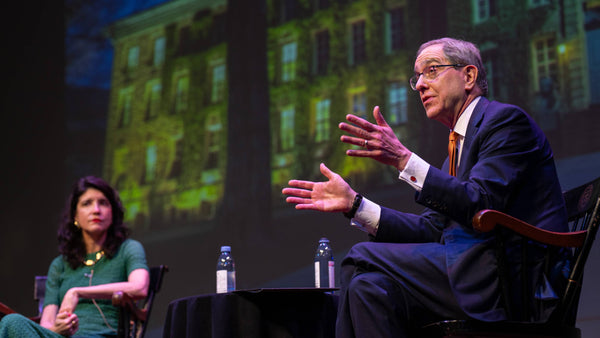
On Sunday, May 24, Princetonians for Free Speech (PFS) hosted a breakfast at the Nassau Inn — and despite dreary skies outside, the energy inside couldn't have been brighter. About 70 alumni, current students and other free speech supporters turned out for what proved to be an engaging and inspiring morning.
As I complete my undergraduate studies at Princeton University, I find myself reflecting on the purpose of education. This article aims to articulate my understanding of education in an abstract sense and to advance a normative argument grounded in the classical tradition. I address more concrete implications of the historical vocation of education in greater depth in my essay published last October by PFS,The Ideal of the University.
In having a truly diverse group of students share their perspectives, Princeton makes known that there exists a home for every viewpoint. However, as much as I believe this claim to be true, there are unfortunately those who do not. It is easy to dismiss the Princeton administration and culture as entirely polarizing and ideologically biased. In fact, it is true that many here hold the same dominant perspective . But to focus on this fact alone, to rest our entire judgement on one such observation, runs the dangerous risk of neglecting the clear and persistent efforts of this University to encourage every student—even the conservative ones—to share the beliefs that he or she so earnestly pursues.
Princetonians for Free Speech (PFS) today announced a landmark achievement: its email subscriber list has officially surpassed 26,000 verified subscribers, approximately 80% of which are alumni, representing one of the most significant milestones in the organization's history since its founding in late 2020. This high number represents a highly engaged network of supporters committed to preserving the fundamental value of free speech at Princeton.
I contend that the narrow, politicized curatorial approach of the new Princeton Art Museum’s American wing turns our nation’s vibrant story into a muted tapestry. Like a quilt losing meaning when its unique patches are made uniform, the exhibit elevates grievance over achievement, division over unity, and progressive ideology over historical accuracy. The overall structure, deliberate additions, and obvious omissions dull the nation’s artistic vibrancy and overlook Princeton’s remarkable place in the American experiment.
The first step to recovery is admitting you have a problem. For years, the core argument of Princetonians for Free Speech was treated by university administrators as a provocation rather than a diagnosis. The claim that American higher education had drifted from its foundational mission, that a culture of ideological conformity and administrative overreach had corroded the open inquiry that justifies the university’s privileged place in democratic life, was dismissed as politically motivated, answered with defensive boilerplate, or simply ignored. That era appears to be ending. No dramatic reversals have taken shape yet, but something significant is happening. The academy itself—the ivory tower that prides itself on being above and beyond the slings and arrows of the outside world—is beginning to acknowledge that the critics had, and have, a point.