


Abigail Readlinger
‘27
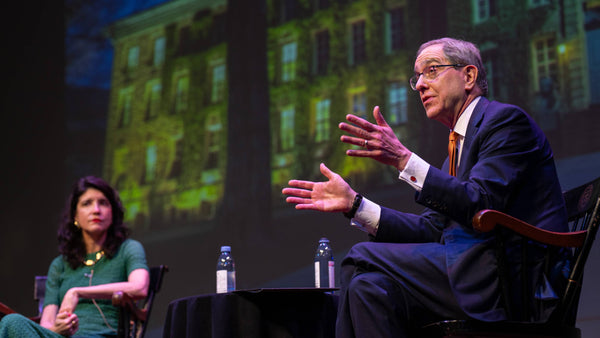
On Tuesday, March 26th, over forty Princeton students gathered for the second ever Turning Point USA Princeton chapter meeting. They listened intently as Theo Wold, former Acting Assistant Attorney General in the Office of Legal Policy at the Department of Justice and Deputy Assistant to the President for Domestic Policy, spoke to them on the values of common sense conservatism and the need to cultivate the virtue of plain speech.
Wold’s lecture exemplifies the mission of Princeton TPUSA. According to President and Co-Founder Tommy Feroce ‘26, the group was formed in response to the assassination of TPUSA Executive Director Charlie Kirk on September 10, 2025. For Feroce, Kirk’s death indicated a “failure on students to bring conservative ideas to [their] classmates.” He, like many others, was disheartened by such political violence and the clear violation of free speech. “If someone can be killed for the words they say, we are getting to a really bad place.”
Princeton TPUSA was an effort to correct such a failure and to encourage conservative ideas.
Feroce and his co-founders believed that the chapter, while certainly not the only conservative group on campus, would fulfill a unique need. “There’s a lot of conservatives on campus, a lot of groups,” Feroce notes. But, he added, many of them are focused primarily on “academia and intellectual thought.” The mission of TPUSA, however, as evidenced by Wold’s lecture, revolves around common sense and plain speech. This is a mission, Feroce argued, that would “fill a space for students on campus” and appeal to an untapped group of conservatives seeking to express themselves.
The Co-Founders believed that in benefiting conservative voices, Princeton TPUSA would also benefit speech and discourse at large. Connor Long ‘27, the Liaison for ROTC and Veteran’s Affairs, says “It is important that students are exposed to perspectives they might not encounter in their day-to-day environment. Groups like TPUSA help create space for those conversations.” Rocco Marcelino ‘27, the Treasurer, echoes similar sentiments. He believes TPUSA is a “necessary addition to have on this campus.” Allowing students to hear from “successful conservative figures” allows like-minded students to find and form communities, while also “promo[ting] and foster[ing] healthy discourse” throughout the entire campus.
Such discourse is especially needed at Princeton. According to another co-founder, Princeton is a place “where we are taught that courage is the willingness to speak truth into opposition and fervently defend it with the undeniable facts.” She believes that such a definition is aligned with the ultimate purpose of TPUSA. Indeed, our University ought to encourage such a group because the missions of each are inextricably connected. Students must be given any and every opportunity to shape their beliefs by listening to and learning from the diversity of the voices around them.
It has been therefore encouraging to see the University’s support of Princeton TPUSA. When asked how the club was perceived by the administration, Feroce responded positively. “The school itself has been great. As soon as we said we wanted to start this, they appointed a Dean to make sure, to make sure, we were accepted as a club. There were a couple hiccups with the Undergraduate Student Government (USG), but the Dean intervened and made sure it got done.” Though it seems there was some initial reluctance on behalf of the student body, Princeton TPUSA is now officially recognized by the University, receives school funding, and is advertised throughout campus. And student interest has certainly not been lacking. Over a hundred students have joined the club’s messaging platform, and more than fifty have attended either some activity or event since the beginning of the semester. According to Long, “TPUSA was one of the fastest growing political organizations Princeton has seen to date. Charlie Kirk's death inspired many students to unite together and recognize that his death reflected the negative sentiments that many college students have towards conservative viewpoints, and many students from all backgrounds united in the creation of Princeton's new TPUSA chapter.” Marcelino agrees, saying, “Student interest is definitely evident. Our kickoff meeting, which took place in the midst of a blizzard, had sixty people in attendance.” With such numbers, the Co-Founders believe the Princeton chapter is the largest out of all Ivy League chapters.
Despite its impressive size and administrative support, students note that members of TPUSA can expect pushback on their position. Long explains that it is not uncommon for students to be labeled as “‘uneducated’” or “‘immoral’ simply for having different views.” Marcelino too has personally found that “conservative voices and messages tend to be suppressed and frowned upon.” As a result, many students are uncomfortable sharing their views, especially when it comes to certain social situations. TPUSA, however, actively works to fight the narrative that conservative students must keep to themselves. Regardless of any opposition, these students believe that finding a space for common sense conservative values to be celebrated, supported, and discussed is of utmost importance. “I’ve stood my ground,” Long says in encouragement, “Everyone should be allowed to voice their beliefs and nobody should be ashamed.”
TPUSA was started not only to give conservatives a voice. It was started to send a message. A message on the value of common sense, of honest conversation, and of free speech. Our current generation has left these values grossly unattended to. And we must work to revive them. As Theo Wold so resolutely declared in the chapter meeting just one month ago, we must cultivate the virtues most conducive to the flourishing of speech. We must be determined, but also open-minded. We must be brave, but also humble. We must speak, but we must also listen. This is the mission of Princeton TPUSA. And we ought to be proud of having such a group in our midst.
Abigail Readlinger ‘27 is a Junior in the Politics department from Princeton, NJ. She is a PFS Writing Fellow.
Leave a comment
Comments will be approved before showing up.